

Blog
Wie man Übersprechen auf einer Leiterplatte reduziert
Crosstalk is unintended electromagnetic coupling between nearby PCB signal traces, where one trace (the aggressor) induces voltage or current disturbances on another trace (the victim). In high-speed PCB designs, with faster edge transitions, tighter trace spacing, and lower noise margins, crosstalk can seriously affect signal integrity. It can distort the victim signal’s amplitude, timing, or edge shape, leading to data errors, jitter, or false switching.
For this reason, controlling crosstalk is no longer optional; it is a core PCB engineering requirement. In this article, we explore the main causes of crosstalk and share practical strategies to reduce it, helping engineers achieve reliable, high-performance PCB.
Primary Causes of Crosstalk in PCB Layouts
Insufficient Trace Spacing
Ursache:
Traces placed too close increase parasitic capacitance and mutual inductance.
Effect:
Even low-frequency signals can induce crosstalk.
Long Parallel Routing
Ursache:
Long parallel traces act as loosely coupled transmission lines.
Effect:
The longer the parallel run, the more energy is transferred between traces, increasing NEXT (Near-End Crosstalk) and FEXT (Far-End Crosstalk).
Poor Layer Stack-Up
Ursache:
Signal layers adjacent with no solid reference plane.
Mixing high-speed and sensitive signals on the same layer.
Effect:
Unstable return paths, larger loop areas, higher crosstalk.
Broken or Split Ground Planes
Ursache:
Return currents detour around splits in ground planes.
Effect:
Loop area increases.
Magnetic coupling significantly increases.
Crosstalk and EMI rise together.
Fast Edge Rates (Not Just High Frequency)
Ursache:
Signal rise/fall times determine coupling more than clock frequency.
Example: A 1 MHz signal with a 1 ns edge behaves like a GHz signal.
Effect:
Fast edges increase crosstalk potential even at relatively low frequencies.
When Crosstalk Becomes a Real Problem
Crosstalk can seriously affect PCB signal integrity when the system type and design characteristics make it sensitive:
| System Type | Typical Risk |
|---|---|
| High-speed digital (>100 MHz) | Timing errors, jitter |
| DDR / Memory buses | Bit flips |
| ADC / DAC analog inputs | Increased noise floor |
| RF & mixed-signal | Spurious emissions |
| Long parallel buses | False triggering |
A common design target:
Crosstalk < –50 dB (~0.3%) for high-speed links
Crosstalk results from the electromagnetic fields around current-carrying traces. It is not caused by “noise leaking through copper,” but by electric and magnetic fields interacting with nearby conductors. These interactions occur via two mechanisms: capacitive coupling and inductive coupling.
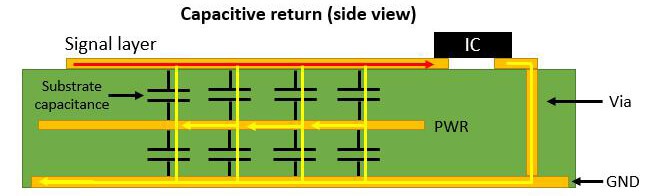
Capacitive Coupling (Electric-Field Driven)
Mechanismus
A changing voltage on one trace induces an electric field that couples to a nearby trace, creating an unwanted voltage. The aggressor and victim traces form a parasitic capacitor.
Strengthened by:
- Closely spaced traces (higher capacitance)
- Fast voltage transitions (high dV/dt)
- High PCB dielectric constant (Dk)
Faustregel:
Faster edge rates increase capacitive coupling, regardless of clock frequency.
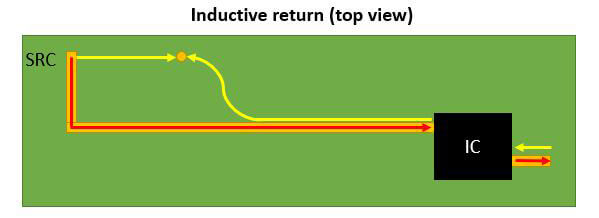
Inductive Coupling (Magnetic-Field Driven)
Mechanismus
A changing current in one trace produces a magnetic field that links a nearby trace, inducing a voltage via mutual inductance.
Strengthened by:
- Large current loop areas
- Discontinuous or detoured return paths
- Broken or poorly referenced ground planes
Faustregel:
Poor or discontinuous return paths significantly amplify magnetic coupling, even if trace spacing seems sufficient.
How to Identify Crosstalk on an Existing PCB
Visual Layout Inspection
Look for design features that may promote crosstalk:
- Long parallel traces
- High-speed digital signals routed near sensitive analog lines
- Plane splits under critical nets
Oscilloscope Clues
Use an oscilloscope to spot crosstalk effects:
- Small voltage steps coinciding with edges on neighboring signals
- Jitter correlated with bus activity
- Noise bursts during switching events
Simulation & EDA Tools
Employ software to predict or verify crosstalk issues:
- Signal integrity simulators for high-speed nets
- Crosstalk analysis tools to quantify coupling
- Design Rule Check (DRC) spacing rules to ensure adequate trace separation
Step-by-Step Strategies to Reduce Crosstalk in PCB
Control Trace Geometry and Spacing
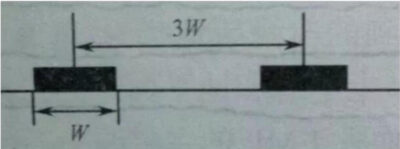
Apply the 3W / 5W / 10W Rule:
- 3W: Minimum acceptable spacing
- 5W: Good for digital signals
- 10W: Analog, RF, or sensitive signals
Example: 6 mil trace → ≥18 mil spacing (3W)
Reduce Parallel Length:
- Keep parallel routing as short as possible
- Introduce staggered routing
- Break symmetry
Route Adjacent Layers Orthogonally:
- Layer 1: Horizontal
- Layer 2: Vertical
Avoid Right-Angle Bends:
- 45° bends
- Smooth curves
Master Grounding and Return Paths
Provide a Solid Reference Plane
A continuous ground plane:
- EM fields
- Minimizes loop inductance
- Reduces inductive crosstalk
Never Route High-Speed Signals Over Plane Splits
Return currents follow the signal path
Plane gaps force detours → more coupling
Stitch Grounds Near Signal Transitions
Place vias:
- Near layer changes
- Near connectors
- Near plane edges
Optimize Layer Stack-Up
Bad Stack-Up (High Crosstalk Risk)
Signal layers adjacent without reference planes:
- Signal
- Signal
- Kraft
- Boden
Good Stack-Up (Low Crosstalk):
Signal layers separated by ground/power planes:
- Signal
- Boden
- Kraft
- Signal
Use Guard Traces Correctly
Only effective when grounded properly.
Regeln
- Stitch to ground frequently (≤ λ/10)
- Never leave floating
- Do not rely on them alone
Use Differential Pairs Correctly
Reduce crosstalk only when:
- Tight coupling within the pair
- Consistent spacing
- Längenabgleich
- Same reference plane
Material Selection
Use low dielectric constant (Dk) materials in:
- High-speed backplanes
- RF boards
- GHz designs
Real-World PCB Example
Problem
SPI bus randomly fails at 40 MHz; ADC shows noise spikes
Root Cause:
Parallel routing between SPI clock and ADC input; broken ground plane
Korrektur:
- Reroute SPI perpendicular to ADC
- Add solid ground reference
- Increase spacing to 5W
Ergebnis:
Zero bit errors; 8 dB noise reduction
Abschließende Gedanken
Crosstalk is not an unpredictable side effect of complex electronics. It is a direct and repeatable outcome of electromagnetic interactions determined by PCB geometry, material properties, and signal behavior. Because these interactions follow physical laws, crosstalk can be analyzed, measured, and controlled—provided layout decisions are made deliberately, rather than intuitively.
Bei PCBCool, we combine decades of PCB expertise with strong engineering support to ensure your project is more than just manufacturing. Partnering with us means your design is approached as a complete engineering system, where signal integrity, crosstalk control, and high-speed PCB performance are carefully considered at every stage.
Häufig gestellte Fragen (FAQ)
A: No. 3W rule can significantly reduce crosstalk, but it does not eliminate it entirely. At high frequencies or over long parallel runs, electromagnetic fields can still couple between traces.
A: Not necessarily. A ground plane only provides a proper return path if it is continuous, uninterrupted, and close to the signal layer.
A: No. Differential signaling reduces noise and radiation but does not make traces immune to interference.
A: No. Crosstalk is influenced more by signal edge rate (rise/fall time) than by the nominal clock frequency.
A: Only partially. Software or digital filtering can suppress the symptoms of crosstalk, but it does not address the root causes such as poor trace spacing, bad return paths, or layer stack-up issues.
A: It depends on the proximity of reference planes. Inner layers with continuous ground or power planes can be safer, while inner layers without proper planes or with gaps may experience more inductive or capacitive coupling.
A: There is no single rule. Adequate spacing depends on signal rise time, impedance, layer stack-up, and operating frequency, not just trace width.
Silke Scherer verfügt über mehr als 12 Jahre Erfahrung in den Bereichen Schaltungsentwurf und Leiterplattenlayout. Sie ist spezialisiert auf die Erstellung klarer Schaltpläne, zuverlässiger Leiterplattenlayouts und produktionsfertiger Dokumentation mit Altium Designer, wobei sie sich stark auf Genauigkeit, sauberes Routing und Herstellbarkeit konzentriert.