Blog

Was ist Übersprechen (Crosstalk) im PCB-Design?

0
Was ist Übersprechen (Crosstalk) im PCB-Design?

Even if a PCB passes every design check, it can still fail during testing. The schematic may be correct. Firmware may run as expected. Power rails may be stable and within specification. Yet the board behaves unpredictably: intermittent resets, corrupted data, excessive jitter, or unexplained noise.

In many cases, the problem is crosstalk. Unlike obvious faults such as shorts, opens, or missing power supplies, crosstalk is subtle. It doesn’t come from a failed component but from electromagnetic coupling between nearby traces.

Because of this, crosstalk often goes unnoticed during schematic review and basic layout checks, only becoming visible during debugging or signal integrity analysis.

If you are new to PCB design, understanding crosstalk is essential. In this article, we will explain what crosstalk is, why it occurs, and the different types you may encounter in real PCB layouts.

What Exactly is Crosstalk in PCB

In simple terms, crosstalk refers to electromagnetic coupling between adjacent signal traces on a PCB, causing energy from one trace to unintentionally couple into another. This interference can introduce noise and distortion on the affected signal, potentially disrupting the normal operation of the circuit.

To visualize this, imagine several signal traces running close to each other on a PCB. When current flows through one trace (the aggressor), it generates a weak electromagnetic field. This field can interact with nearby traces (the victims), inducing small unwanted signals on them. This phenomenon is known as crosstalk.

Crosstalk occurs because a signal is not confined to the copper conductor itself. Any trace carrying a time-varying voltage and current generates electromagnetic fields in the surrounding dielectric.

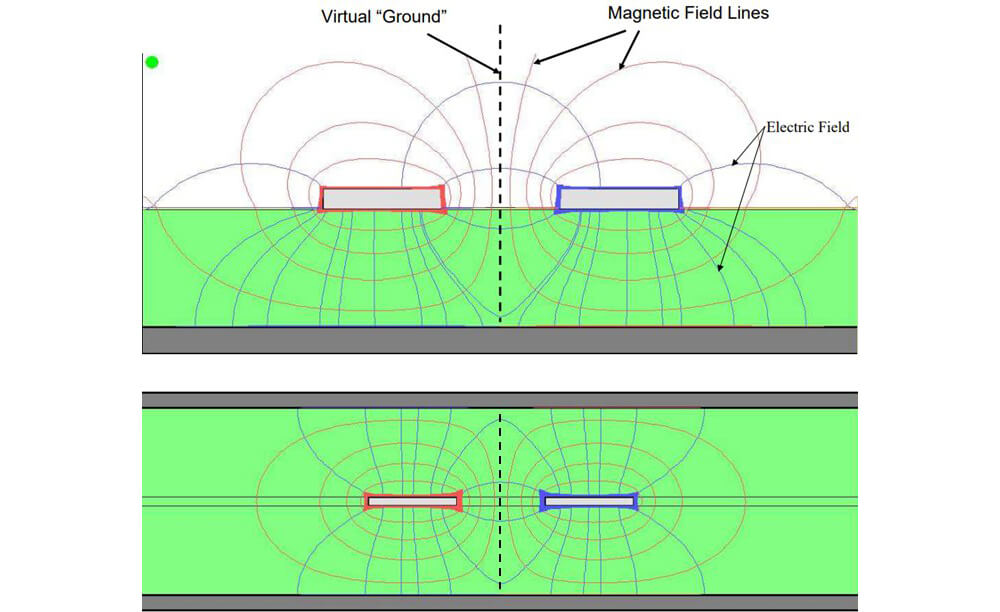
  • Electric fields create capacitive coupling between adjacent traces. When the voltage on the aggressor changes, charge is coupled into the victim trace.
  • Magnetic fields create inductive coupling. When current in the aggressor changes, it induces current in nearby conductors through mutual inductance.
Views of electric and magnetic fields

When traces are close enough for these fields to overlap, energy is transferred from the aggressor to the victim regardless of design intent or signal type. As signal edge rates increase and trace spacing decreases, this coupling becomes stronger. For this reason, crosstalk is an inherent effect of PCB geometry and electromagnetic behavior rather than a schematic-level design error.

Key Insight: Crosstalk is not a software bug. It is simply Maxwell’s equations enforcing physics on your PCB layout.

How is Crosstalk Generated in PCB

Signal Traces Placed Too Close Together

One of the most common mistakes beginners make is placing signal traces too close together to save PCB space. When traces run very close to each other, the electromagnetic field generated by one trace can easily couple into a nearby trace.

For example, if a high-speed clock trace runs only 0.1 mm away from another signal trace, the changing voltage and current on the clock line can induce unwanted signals on the adjacent trace, introducing noise and signal distortion.

Long Parallel Routing Between Signal Traces

Even when traces are not extremely close, crosstalk can still become significant if they run parallel to each other for a long distance. The longer two traces remain parallel, the longer their electromagnetic fields interact, which increases the total coupled energy.

For example, if two signal traces run parallel for 50 mm on a PCB, the accumulated coupling along the length of the traces can introduce noticeable interference.

Lack of a Proper Reference Plane (Ground or Power Plane)

A reference plane on a PCB—typically a ground plane—helps contain electromagnetic fields and provides a stable return path for signals. This significantly reduces unwanted coupling between signal traces.

If a PCB lacks a solid reference plane, or if the plane is broken by gaps or splits, the electromagnetic fields generated by signal traces can spread more widely across the board. As a result, nearby traces are more likely to pick up interference.

What are the Typical Effects of Crosstalk on a PCB

Signal Waveform Distortion

Ideally, digital signals appear as clean square waves with well-defined rising and falling edges. When crosstalk occurs, unwanted noise from nearby traces can distort the signal waveform.

This distortion may appear as glitches, ringing, or small voltage fluctuations on the signal line. In severe cases, these disturbances can push the signal across the logic threshold, causing incorrect logic detection.

For example, a signal that should remain at a stable high level may briefly dip due to interference from a nearby aggressor trace, potentially causing a logic error.

Signal Jitter and Timing Uncertainty

Crosstalk can introduce timing variations in affected signals. When interference alters the voltage waveform of a signal, the moment at which it crosses the logic threshold may shift slightly.

This results in jitter, where the signal edge arrives earlier or later than expected.

In high-speed digital interfaces or clock signals, excessive jitter can lead to timing violations and unreliable circuit operation.

False Triggering or Data Errors

Another common symptom of crosstalk is unintended signal triggering.

For example:

  • A control signal may falsely activate another function.
  • LEDs that should remain stable may flicker.
  • During serial communication, data corruption or packet loss may occur.

These issues often appear random during debugging but may actually be caused by electromagnetic coupling between nearby signal traces.

NEXT and FEXT

Crosstalk in transmission lines is commonly classified based on where the interference is observed along the victim trace. The two fundamental forms are Near-End Crosstalk (NEXT) and Far-End Crosstalk (FEXT). Both arise from electromagnetic coupling between adjacent traces but appear at different locations due to signal propagation along the transmission line.

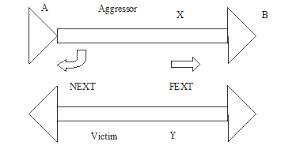
Diagrams of NEXT and FEXT

Near-End Crosstalk (NEXT)

Near-End Crosstalk is the unwanted noise measured at the source (transmitting) end of the victim trace, close to the driver.

NEXT results from both capacitive and inductive coupling between adjacent traces. Rapid voltage and current transitions on the aggressor trace generate electric and magnetic fields that induce a disturbance on the nearby victim trace. This disturbance appears almost immediately at the near end of the victim trace.

Because NEXT depends primarily on the instantaneous coupling between traces, it can occur even when the parallel routing length is relatively short, especially when signal edge rates are fast.

Key characteristics of NEXT:

  • Observed at the transmitting end of the victim trace
  • Appears near the signal source
  • Strongly influenced by trace spacing, edge rate, and dielectric properties

Far-End Crosstalk (FEXT)

Far-End Crosstalk is the unwanted noise measured at the receiving end of the victim trace, near the load.

FEXT results from the combined effect of capacitive and inductive coupling along the coupled length of the traces. Unlike NEXT, the induced disturbance travels in the same direction as the aggressor signal and arrives at the far end after propagating along the transmission line.

In many PCB transmission structures, the capacitive and inductive coupling components partially cancel each other, which is why FEXT is often smaller than NEXT. However, as the parallel routing length increases, FEXT can become more noticeable.

Key characteristics of FEXT:

  • Observed at the receiving end of the victim trace
  • Travels in the same direction as the aggressor signal
  • Increases with longer parallel routing and poor return paths
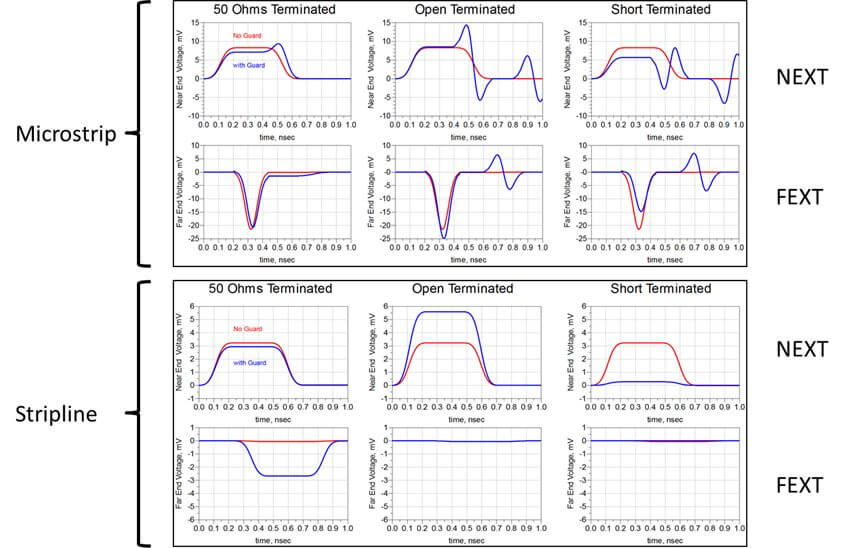
The performance of NEXT and FEXT in microstrip lines and striplines, respectively

Abschließende Gedanken

As a beginner, you don’t need to aim to completely eliminate crosstalk. In most simple PCB circuits, keeping crosstalk within acceptable limits is sufficient for the device to operate properly. As you gain more design experience, you can gradually apply more advanced techniques—such as controlled impedance routing and shielding—to design more stable and reliable PCB.

If you’re interested in learning more about PCB design, the PCBCool blog provides a wide range of beginner-friendly resources. Additionally, for electronic device manufacturers without in-house PCB design capabilities, PCBCool’s experienced engineering team can help turn product concepts into fully manufactured PCB.

Häufig gestellte Fragen (FAQ)

Q1: Is Crosstalk Only a Problem for High-Frequency Signals?

A: No! Low-frequency signals can also experience crosstalk, though the effect is generally weaker than with high-speed signals.

Q2: Will Thicker Traces Reduce Crosstalk?

A: Not necessarily. Crosstalk is primarily influenced by trace spacing, parallel routing length, and reference plane quality—not the trace width.

Q3: Does Simply Having a Ground Plane Eliminate Crosstalk?

A: No. A ground plane helps reduce crosstalk but cannot completely eliminate it. Gaps, splits, or poorly routed ground connections can still allow coupling between traces.

Q4: Can Vias Increase Crosstalk?

A: Yes. Vias can introduce impedance discontinuities and alter return current paths, which may increase electromagnetic coupling between traces.

Q5: Are Multi-Layer PCBs Immune to Crosstalk?

A: No. Multi-layer PCBs with proper ground and power planes help reduce crosstalk, but improper layout or long parallel traces can still lead to interference.

Q6: Can Signal Rise/Fall Time Impact Crosstalk?

A: Yes. Faster edge rates generate stronger electromagnetic fields, which increase the likelihood and severity of crosstalk.

Q7: Can Crosstalk Be Measured During PCB Testing?

A: Yes. Signal integrity analysis, oscilloscopes, and TDR (Time Domain Reflectometry) can be used to detect crosstalk on a PCB.

Q8: Is Crosstalk the Same as EMI?

A: Not exactly. Crosstalk is a form of electromagnetic interference (EMI) that specifically occurs between PCB traces, while EMI can come from external sources as well.

Silke Scherer
Silke Scherer | Spezialistin für Leiterplatten- und Hardware-Design

Silke Scherer verfügt über mehr als 12 Jahre Erfahrung in den Bereichen Schaltungsentwurf und Leiterplattenlayout. Sie ist spezialisiert auf die Erstellung klarer Schaltpläne, zuverlässiger Leiterplattenlayouts und produktionsfertiger Dokumentation mit Altium Designer, wobei sie sich stark auf Genauigkeit, sauberes Routing und Herstellbarkeit konzentriert.

Verwandte Schlagwörter