
Blog
Wave Soldering Process for Through-Hole PCB Assembly
Many electronic products still rely on through-hole components for connectors, transformers and other parts that require strong mechanical support or higher current-carrying capability. For high-volume production of these assemblies, manually soldering every lead is neither practical nor consistent. Manufacturers instead use wave soldering, an automated process that forms hundreds of solder joints in a single pass. As the printed circuit board (PCB) moves across a carefully controlled wave of molten solder, the exposed component leads and plated through-holes are soldered simultaneously, producing reliable electrical and mechanical connections with high repeatability.
3 Common Through-Hole Soldering Methods
| Comparison Point | Single-Wave Soldering | Dual-Wave Soldering | Selective Soldering |
|---|---|---|---|
| How It Works | Uses one solder wave to solder the board underside. | Uses an active wave followed by a smoother wave. | Uses a small programmable nozzle to solder selected joints. |
| Best For | Simple through-hole boards. | Denser through-hole or mixed-technology boards. | Complex boards with only limited through-hole areas. |
| Heat Exposure | Exposes the solderable underside to one full wave. | Still exposes the underside, but with better solder control. | Limits heat exposure to selected soldering points. |
| Production Speed | Fast and economical for simple layouts. | Fast, but requires more process tuning. | Slower, but more precise. |
| Main Control Focus | Wave height, conveyor speed, and drainage. | Balance between the two waves and bridging control. | Nozzle path, dwell time, and local heat control. |
| Typical Applications | Power supplies, appliances, industrial controls. | Mixed-technology PCBAs, connector-heavy boards. | Automotive, aerospace, medical, high-density PCBAs. |
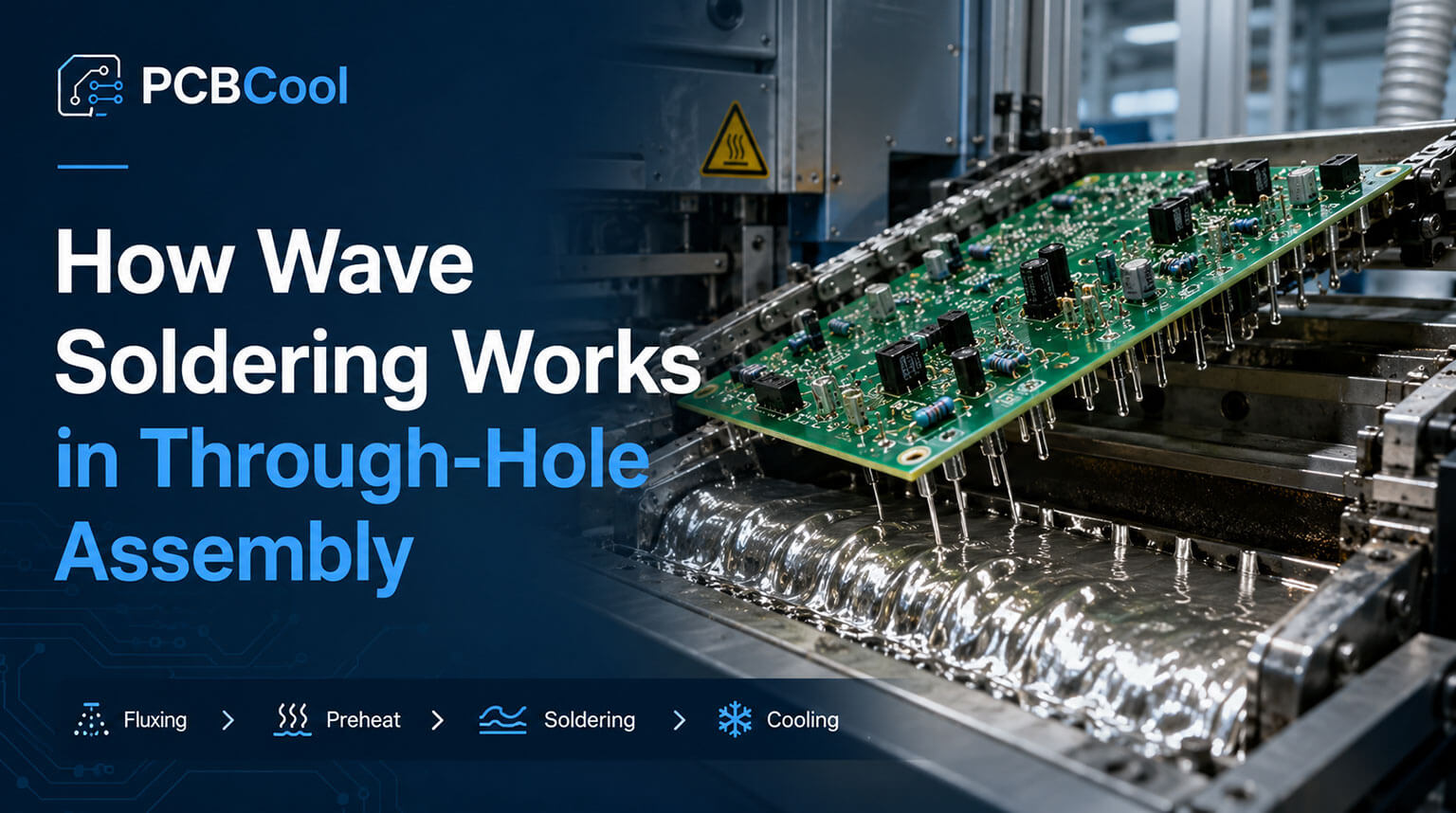
Wave Soldering Process Flow
Step 1: Flux Application
The process begins with the application of flux to the underside of the PCB. Modern wave soldering machines typically use spray fluxing systems, while some older systems use foam fluxers. In mixed-technology assemblies, selective fluxing may also be employed to apply flux only where soldering is required.
The flux removes surface oxides from PCB pads, plated through-holes, and component leads while protecting these surfaces from further oxidation during soldering. It also improves solder wetting, allowing the molten solder to spread uniformly across the metal surfaces.
Careful control of the amount and coverage of flux is crucial. Insufficient flux can result in poor wetting and incomplete hole fill, whereas excessive flux may leave unwanted residues or contribute to soldering defects.
Step 2: Preheating
After flux application, the PCB enters one or more preheating zones that use infrared heaters, convection heaters, or a combination of both. The objective is not to melt solder but to prepare the assembly for contact with the molten solder wave.
Preheating gradually evaporates volatile solvents from the flux, activates the remaining flux chemistry, and reduces the thermal shock that would otherwise occur when the PCB contacts solder at temperatures exceeding 250°C. It also helps equalize the temperature across the assembly, particularly for multilayer PCBs or boards containing large copper planes and high thermal mass components.
Step 3: Solder Wave
The soldering stage is the heart of the wave soldering process. Molten solder is stored in a temperature-controlled solder pot beneath the conveyor. A mechanical pump continuously circulates the solder through specially designed nozzles to generate one or more stable solder waves. As the PCB moves across the machine on an inclined conveyor, only the underside of the board comes into contact with the solder wave, while the component side remains above the molten solder.
During this brief contact, several processes occur almost simultaneously. The molten solder wets the exposed copper pads and component leads, displacing the activated flux from the joint area. Capillary action then draws the solder upward into the plated through-holes, allowing the barrel to fill and forming metallurgical bonds between the component leads and the copper plating. As the PCB leaves the wave, surface tension removes excess solder, leaving behind smooth fillets that provide both electrical continuity and mechanical support.
The design of the solder wave has a significant influence on solder joint quality. A single-wave system is generally sufficient for conventional through-hole assemblies with relatively simple layouts. However, assemblies containing closely spaced leads or mixed-technology components often benefit from a dual-wave configuration. The first, turbulent wave improves solder penetration around dense component leads and enhances hole filling, while the second, smooth laminar wave removes excess solder and helps reduce defects such as solder bridging, icicles, and uneven fillet formation.
Although the contact between the PCB and the solder wave lasts only a few seconds, this stage determines the quality of every solder joint on the assembly. Solder temperature, conveyor speed, conveyor angle, wave height, immersion depth, and contact time must all be carefully balanced to achieve complete hole fill without exposing the assembly to unnecessary thermal stress. These process parameters are discussed in detail in the following section.
Step 4: Cooling
After leaving the solder wave, the assembly enters the cooling stage, where the molten solder solidifies to form permanent electrical and mechanical connections. Controlled cooling helps produce stable solder joints while minimizing thermal stresses within the PCB and its components. Once cooled, the PCB proceeds to inspection and electrical testing before moving to the next stage of manufacturing.
Key Wave Soldering Parameters
| Parameter | Typical Range |
|---|---|
| Solder Pot Temperature | 245–260°C (lead-free) 245–250°C (SnPb) |
| Preheat Temperature | 90–130°C (PCB topside) |
| Conveyor Speed | 0.8–1.8 m/min |
| Contact Time | 2–4 seconds |
| Conveyor Angle | 5°–7° |
| Wave Height | 50–70% of PCB thickness |
| Flux Application | Approximately 2–5% solids (depends on flux type) |
How to Adjust Wave Soldering Parameters
The parameter ranges above are useful as starting points, but they should not be treated as fixed settings for every PCB assembly; these parameters are connected, and changing one often affects the others.
Conveyor speed is a good example. It directly affects how long the PCB remains in contact with the solder wave. If the board moves too quickly, the solder may not fully fill the plated through-holes, resulting in insufficient solder joints. If the board moves too slowly, the assembly receives more heat, which may contribute to solder bridging, excessive solder deposits, or component damage.
Solder pot temperature has a similar balance. The solder must remain sufficiently above its melting point to wet the pads, component leads, and plated through-holes. However, a higher temperature is not always better. Excessive solder temperature can consume flux too quickly, increase oxidation and dross formation, and expose components to unnecessary thermal stress.
For this reason, parameter adjustment should be handled as a process balance rather than a single-value correction. If conveyor speed is increased, solder temperature, wave height, and preheating may also need to be checked to maintain adequate solder contact and hole fill. If poor wetting appears, the answer is not always to raise the solder pot temperature; flux coverage, preheat condition, contact time, and board design should also be reviewed.
Thermal Profiling in Wave Soldering
Thermal Profiling is used to confirm whether the preheating section provides enough heat for solvent evaporation and verify that the board experiences the intended solder contact condition during soldering.
During profiling, a representative PCB is fitted with thermocouples attached to selected pads, plated through-hole leads, or critical component locations before passing through the complete wave soldering process. Industry standards such as IPC-TM-650 and IPC-7530 provide guidelines for thermocouple attachment and profile measurement.
In robust lead-free processes, the PCB topside typically reaches 110–130°C before soldering. In wave soldering, the time above liquidus (TAL) is essentially the contact time between the PCB and the molten solder, and it should remain within the required process window. The profile also confirms that the PCB cools below approximately 100°C before leaving the cooling section.
After profiling, the recorded temperatures are analyzed to identify cold spots and hot spots, and the process is adjusted accordingly.
Final Thoughts
Wave soldering is not just a legacy process kept alive by older PCB designs. In modern PCBA manufacturing, it remains a practical way to turn through-hole design requirements into stable, repeatable production results.
At PCBCool, we support wave soldering for suitable through-hole and mixed-technology assemblies. When a project includes larger plug-in components, oversized connectors, or parts that are better handled individually, our manual through-hole soldering lines provide the flexibility needed to complete the assembly with the right process rather than forcing every board through the same route.
FAQs
A: The main reason is that each added layer makes the manufacturing process harder to control. More layers mean more chances for inner-layer defects, alignment issues, lamination problems, and scrap.
A: BGA pads are small and closely spaced, so small manufacturing errors can easily become assembly problems.
Andy is an experienced PCB industry professional with decades of experience in PCB manufacturing, assembly, and customer support. At PCBCool, he leads the marketing team and helps turn practical project experience into useful technical content for engineers, buyers, and product developers.