
Blog
Key FR-4 Material Properties and Datasheet Values for PCB
For professionals in the electronics industry, FR-4 is a familiar term. It is widely used in electronics manufacturing, especially in PCB fabrication, where FR-4 is often regarded as one of the most common and standardized substrate materials available.
Strictly speaking, however, FR-4 is not a specific material brand, nor is it a single standard laminate with fixed performance values. It refers to a class or grade of flame-retardant, glass-fiber-reinforced epoxy laminate materials. Different FR-4 materials can vary significantly in Tg, Dk, Df, coefficient of thermal expansion, CAF resistance, halogen-free requirements, and long-term reliability.
This is why, in real projects, selecting FR-4 is not simply a matter of saying “use FR-4.” Engineers and buyers also need to understand the performance differences between specific material grades and match those characteristics with the project’s electrical performance, thermal management, manufacturing process, and reliability requirements.
This article explains FR-4 materials from a practical perspective. It covers the main material properties of FR-4, the key parameters commonly found in datasheets, how these parameters affect PCB design, and what should be checked during the material selection stage, with the goal of supporting smoother project development and more reliable project execution.
Why FR-4 Is Used So Widely
The reason is simple: it provides a practical balance of electrical, mechanical, thermal, and cost performance. The glass fiber reinforcement gives the laminate rigidity and dimensional stability, while the epoxy resin binds the structure together and provides electrical insulation between conductive layers. This combination allows FR-4 PCBs to remain mechanically stable while preventing current from flowing between areas that should remain isolated.
FR-4 is also well suited to standard PCB manufacturing processes. It can be drilled, routed, laminated, plated, solder-masked, and assembled using mature production methods. This process compatibility helps PCB manufacturers control cost and lead time, while giving designers a predictable material platform for many types of electronic products.
For many standard applications, FR-4 offers enough performance without making the board unnecessarily expensive or difficult to manufacture. That is why it is commonly used in consumer electronics, power supplies, home appliances, industrial control boards, communication devices, and many other electronic products. Its popularity comes not from being the highest-performance PCB material, but from being a reliable and economical choice for a wide range of designs.
Main FR-4 Material Properties
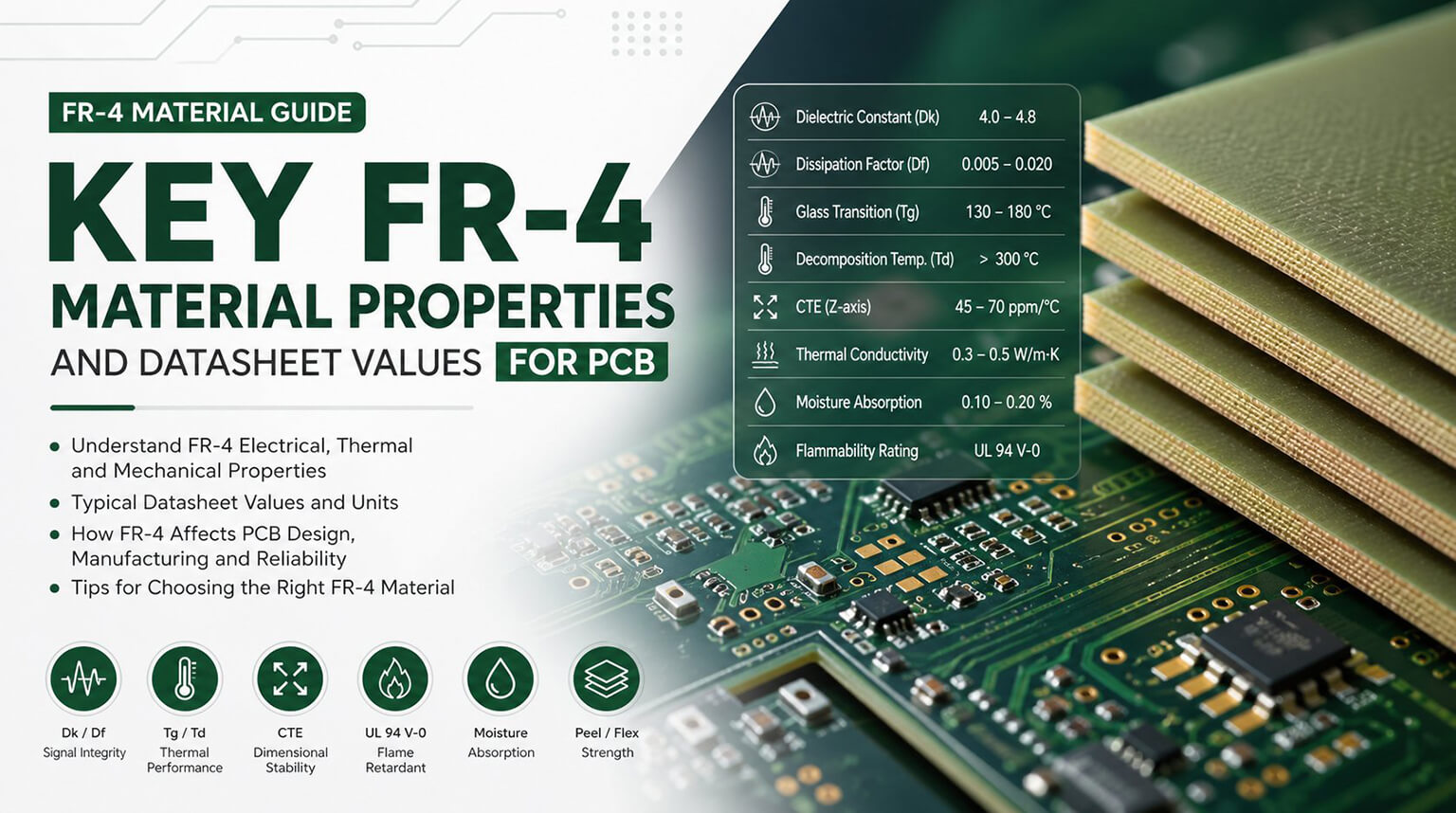
FR-4 possesses numerous properties that are critical in practical PCB applications—precisely the metrics that most engineers check first:
| Datasheet Parameter | What It Means | Why It Matters |
|---|---|---|
| Dielectric Constant (Dk) | Shows how much the material slows down electrical signals. | Important for controlled impedance, high-speed routing, RF performance, and stack-up design. |
| Dissipation Factor (Df) | Shows how much signal energy gets lost as heat while traveling through the board. | A lower Df is better for high-frequency or high-speed signals because it reduces signal loss. |
| Glass Transition Temperature (Tg) | The temperature range where the resin system begins to lose stiffness. | Helps evaluate soldering reliability, heat resistance, and dimensional stability. |
| Decomposition Temperature (Td) | The temperature at which the material begins to chemically degrade. | Important for lead-free assembly, high-temperature processing, and long-term thermal reliability. |
| Time to Delamination (T260 / T288) | Shows how long the laminate resists delamination at 260°C or 288°C. | Useful for evaluating performance during lead-free reflow, rework, and repeated thermal stress. |
| Coefficient of Thermal Expansion (CTE) | Shows how much the material expands when heated. | Z-axis CTE is especially important for plated through holes, vias, and multilayer reliability. |
| Thermal Conductivity | Shows how efficiently the laminate transfers heat. | Important for power electronics, LED boards, processors, and other heat-generating components. |
| Moisture Absorption | Shows how much moisture the laminate can absorb. | Affects insulation stability, soldering reliability, and performance in humid environments. |
Typical FR-4 Material Datasheet Values
| Datasheet Parameter | Common Unit / Format | Typical FR-4 Range or Example |
|---|---|---|
| Dielectric Constant (Dk) | — | About 3.8–4.8, depending on grade, resin content, glass weave, thickness, and test frequency |
| Dissipation Factor (Df) | — | Often around 0.020–0.030, depending on grade and test frequency |
| Glass Transition Temperature (Tg) | °C | Standard FR-4: about 130–140°C; high-Tg FR-4: about 150–180°C |
| Decomposition Temperature (Td) | °C | Often around 300°C or higher, depending on laminate grade |
| Time to Delamination | T260 / T288 | Time in minutes at 260°C or 288°C |
| Coefficient of Thermal Expansion (CTE) | ppm/°C | X/Y-axis values are usually lower; Z-axis expansion is higher, especially above Tg |
| Thermal Conductivity | W/m·K | About 0.3–0.4 W/m·K for many standard FR-4 materials |
| Moisture Absorption | % | Often below 0.2%, depending on grade and test method |
The parameters in an FR-4 datasheet are not just numbers on paper. They are an important basis for judging whether a specific FR-4 material is suitable for a PCB project, because they directly affect board performance, reliability, and manufacturing results.
How FR-4 Properties Affect PCB Design
FR-4 material properties affect both electrical performance and manufacturing reliability. For signal integrity, the most important values are usually dielectric constant and dissipation factor. Dk influences impedance, propagation delay, and stack-up design, while Df affects how much signal energy is lost as frequency increases. In low-speed circuits, these values may not create major problems, but in USB, PCIe, high-speed memory, RF, or controlled-impedance designs, the actual laminate data needs to match the values used in the design calculation.
Thermal behavior is another important limitation. FR-4 has limited thermal conductivity, so it should not be treated as the main heat-spreading path in power-dense designs. When a board contains power devices, processors, LEDs, or other heat-generating components, the layout usually needs additional thermal design features. Common methods include larger copper areas, copper pours, wider traces, thermal vias, heat sinks, airflow, and in some cases metal-core or hybrid PCB structures.
FR-4 also affects manufacturing and long-term reliability. Its wide availability and mature processing window make it practical for mass production, but the selected grade still needs to match the assembly process and operating environment. For example, lead-free soldering, multilayer lamination, rework, thermal cycling, humidity, and higher operating temperatures can all expose weaknesses in a low-grade or poorly matched FR-4 material.
What Engineers and Buyers Should Check Before Choosing FR-4
Before selecting FR-4, a few points should be checked carefully.
- Tg rating-
If the board will run hot or go through lead-free soldering which reaches reflow temp. above 260°C, standard FR-4 may not be enough. High-Tg grades provide better thermal stability in those conditions.
- Dk and Df values-
If the board is for high-speed or high frequency work, check the exact electrical values on the datasheet. Do not assume all FR-4 materials behave the same.
- Thermal reliability-
Think about the worst case operating temperature of your design and compare that to the Tg of the material. Always maintain a safety margin.
- Moisture resistance-
FR-4 generally absorbs very little moisture which is good for most indoor applications. For outdoor or humid environment use, verify the exact grade and consider conformal coating as well.
- Flame rating and compliance-
For product safety, the board material should have the right flame retardant rating and meet the needed industry standard.
FR-4 Compared With Other PCB Materials
| Material | Main Strength | Main Limitation | Best Use |
| FR-4 | Cost, strength, insulation, wide availability | Poor heat conduction, not ideal for very high speed | General electronics, consumer products |
| High-Tg FR-4 | Better thermal stability than standard FR -4 | Still limited thermal conductivity | Lead-free soldering , hotter environments |
| Polyimide | High flexibility and heat resistance | More expensive, harder to process | Flexible boards, aerospace, harsh conditions |
| Metal-Core PCB | Excellent heat spreading | Less flexible, more specialised | LED boards, power electronics |
| Low-Loss Laminates (e.g. Rogers) | Very low signal loss at high frequency | Higher cost, less availability | RF, microwave, high speed digital |
Final Thoughts
FR-4 remains popular because it offers a practical balance of electrical insulation, mechanical strength, thermal performance, availability, and cost. For many standard PCB projects, it provides enough performance without making the board unnecessarily expensive or difficult to manufacture.
However, the right FR-4 properties still matter. A standard FR-4 laminate may work well for one project but may not be suitable for another, especially when the design involves lead-free assembly, higher operating temperatures, controlled impedance, dense multilayer structures, humid environments, or stricter reliability requirements.
The smart way to choose FR-4 is to review the datasheet, compare the key electrical and thermal values, and match the material grade to the real needs of the design. When this is done properly, the PCB becomes more reliable, easier to manufacture, and better suited for long-term use.
As a professional FR-4 PCB manufacturer, PCBCool supports customers with FR-4 PCB fabrication, multilayer PCB manufacturing, PCB assembly, and material selection guidance. Whether your project requires standard FR-4, high-Tg FR-4, halogen-free FR-4, impedance-controlled boards, or production-ready PCB assembly, our engineering and manufacturing teams can help you choose a suitable material solution and turn your design files into reliable finished boards.
Frequently Asked Questions (FAQ)
A: Not always. It depends on the manufacturer, the specific project, and customer requirements. For projects with higher reliability demands, such as medical and automotive electronics, AOI is typically performed on every board.
A: Yes. For projects with special quality requirements, PCBCool can follow customer-defined inspection priorities, acceptance criteria, tolerance ranges, or specific defect control requirements.
Loki has worked in international trade and PCB since 2021, with experience in PCB fabrication, assembly, and customer communication. At PCBCool, he supports technical content publishing and helps connect customer inquiries with the right account manager for efficient project follow-up.