In elite sports, peak performance is no longer determined solely by training intensity—it’s about having a finely tuned understanding of the athlete’s physiological state.
In recent years, advances in biosensing technology and artificial intelligence have paved the way for a new category of devices in professional athletics: smart wearables capable of collecting and analyzing physiological data in real time.
Among these, sweat-based biomarker monitoring is emerging as a particularly promising direction. Unlike traditional metrics such as heart rate or motion tracking, these biomarkers provide direct insight into an athlete’s metabolic state, stress levels, and fatigue.
The central challenge, however, is:
👉 How do you compress “laboratory-grade testing capabilities” into a device that can be worn long-term, manufactured at scale, and operate reliably under intense conditions?
This was the core challenge of the project.
On November 21, 2025, PCBCool received an inquiry from a client in Serbia.
The client was an innovative, growth-stage company focused on the intersection of neurotechnology and wearable devices. Their goal was to create a physiological monitoring platform specifically for professional athletes.
During initial discussions, the client explained that they were exploring the development of a wearable capable of tracking human biomarkers and integrating the collected data with existing AI systems. They were seeking a partner with the right manufacturing and engineering capabilities to bring this vision to life.
After a deeper analysis of the client’s requirements, it quickly became clear that this was not a conventional consumer wearable.
Based on the description, the device’s core technical approach included:
- Sweat-based biomarker detection (rather than simple motion tracking)
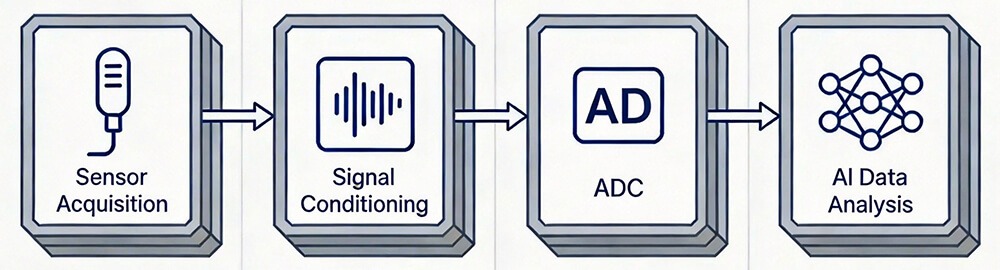
- Integration with AI for real-time data analysis and predictive insights
- Applications in stress management, overtraining alerts, and performance optimization
These use cases demanded a fundamentally different hardware approach.
Unlike ordinary smartwatches or fitness bands, the device had to be engineered for high-intensity environments:
During training and competition, it would be exposed to high humidity, high salt (sweat), and significant physical impact, while still needing to maintain stable and accurate data collection.
Its target users were professional athletes, which meant:
- The device needed to be comfortable for long-term wear
- It had to operate reliably under extreme conditions
- Data had to be highly precise, low-latency, and consistently reproducible
From this analysis, we concluded:
The client was not looking for a “feature-complete” wearable. They needed a hardware platform approaching medical-grade reliability.
Once the project scope was clear, our engineering team broke down the device’s implementation path and identified several critical technical challenges.
These challenges were not isolated to a single component—they spanned materials, structural design, electronics, and manufacturing processes.
Unlike typical electronics, this device would operate in constant contact with sweat, which contains salts (like NaCl), lactic acid, and various metabolites—all of which are corrosive. Typical failure risks included:
- PCB solder joints corroding under high humidity and salt exposure
- Oxidation of metal contacts leading to increased contact resistance
- Localized short circuits or performance drift from prolonged sweat exposure
Our engineering assessment:
Simply relying on a “waterproof rating” (e.g., IP67) is insufficient.
👉 Waterproof ≠ Sweatproof
Sweat is not just a liquid—it’s an electrolytic solution that can accelerate corrosion.
Solution approach:
We recommended mitigating the risk on three fronts:
Apply corrosion-resistant surface treatments (e.g., ENIG or selective gold plating) to key areas, avoiding exposed copper
Seal sensitive areas to prevent sweat accumulation
Apply conformal coating to critical circuit areas to reduce electrochemical migration risk
The device collects both biosignals and chemical sensor signals, which typically exhibit:
- Very low amplitude (μV to mV range)
- High susceptibility to electromagnetic interference (EMI)
- Extreme sensitivity to noise
Typical Risks:
During physical activity, the device faces:
- Unstable contact due to body movement
- EMI from nearby electronic devices
- Noise coupling from its own power systems
Engineering strategy:
In the PCB design phase, we focused on:
- Analog/Digital isolation: Prevent high-speed digital signals from interfering with the analog front end
- Grounding strategy: Use continuous reference planes to reduce return path impedance
- Signal shielding and routing optimization: Short paths, differential or shielded routing for sensitive signals
- Power integrity optimization: Implement filtering and decoupling to minimize power noise
👉 The goal was not just “functional signals,” but long-term stability and repeatability.
A wearable device must conform to the human body while remaining as lightweight and slim as possible.
In practice, this creates clear engineering conflicts:
- Electronic components require space for layout
- Battery size is difficult to reduce
- Structural elements must ensure strength and sealing
Engineering assessment:
Traditional rigid PCBs struggle to meet all these requirements simultaneously:
- Flexibility to adapt to body curves
- Compact, space-efficient design
- Long-term reliability
Solution:
We recommended a rigid-flex PCB solution, which offered the following advantages:
- Flexible circuits in bending areas for body conformity
- Rigid sections in critical component areas to ensure solder reliability
- Reduced need for connectors, improving overall reliability
👉 This approach also reduces internal wiring, improving assembly consistency.
Since the device would be used during high-intensity activity, it needed to be not only waterproof but also:
- Impact-resistant
- Sweat-resistant
- Long-term sealed and stable
Common misconception:
Many projects focus only on achieving an IP rating.
👉 An IP rating is a test result, not a design methodology.
Engineering approach:
We introduced design and process co-optimization from the start:
- Structural sealing design: Use O-rings or sealing grooves to control liquid paths
- Overmolding: Encapsulate core electronics to improve protection
- Interface reliability: Reinforce weak points like buttons and connectors
Because the device is in direct contact with the skin, material selection impacts both comfort and safety.
Key requirements:
- Avoid skin irritation or allergic reactions
- Support long-duration wear (hours or all-day use)
- Meet medical-grade material standards (e.g., ISO 10993)
Engineering guidance:
- Use medical-grade silicone or other biocompatible materials for housing and skin-contact surfaces
- Avoid exposed metals prone to causing allergies
- Reserve design space for material validation and testing
After finalizing the technical approach, the PCBCool team and the client quickly initiated online technical workshops. Engineers from both sides reviewed design schematics, signal processing, material selection, and protective processes in depth to ensure every detail met high standards.
The final design was quickly agreed upon and immediately moved into prototype production. Considering the client’s tight timeline, we provided expedited service:
- From final design to completed PCBA and testing, the full process took just four days
- Throughout, our engineering team maintained close communication with the client, providing timely feedback and iterative improvements
Results of the initial collaboration exceeded expectations:
- The client highly praised our technical capability and responsiveness
- We gained a deep understanding of their innovative requirements, laying a strong foundation for ongoing partnership
The project is now approaching mass production, with plans to advance further after an on-site client visit.
From concept to execution, developing high-end wearables is not just about electronics manufacturing—it’s a systems engineering challenge:
- Technical depth: Rigid-flex PCBs, weak signal handling, waterproofing, sweat corrosion resistance, material biocompatibility
- Engineering experience: From design evaluation to prototype validation and production support
- Client value: High reliability, superior performance, and minimized risk
PCBCool doesn’t just manufacture complex hardware. Through engineering analysis and solution planning, we help clients transform innovative concepts into reliable, high-value wearable products.