banner下面提交表单 (#30)

20+ Years of MCPCB Project Management Experience

Over the past two decades, PCBCool has successfully delivered 5,200+ PCB projects, including numerous applications with stringent thermal performance requirements, such as LED lighting, power modules, power electronics, and automotive electronics.

Within these projects, Metal Core PCB (MCPCB), also known as Insulated Metal Substrate (IMS PCB) or Metal-Backed PCB, are widely used due to their exceptional heat dissipation capabilities. Extensive project experience has not only honed our manufacturing expertise but also provided deep insight into the core thermal management challenges of high-power electronic products.

With a customer satisfaction rate of up to 99.5%, our service capabilities have been thoroughly validated in real-world projects. Upon receiving client design files, our engineering team performs comprehensive reviews and can provide targeted thermal optimization and manufacturability improvement recommendations to help clients achieve more stable and reliable product performance.

MCPCB Technology Capabilities

Aluminum-Based PCBCopper-Based PCB
Quality GradeStandard IPC Class 2/3Standard IPC Class 2/3
Order Quantity1 pc – 10,000+ pcs1 pc – 10,000+ pcs
Layer Count1 – 61 – 6
Thermal Conductivity1 – 4 W/m·K0.3 – 5 W/m·K
Max Board Size1500 × 600 mm1200 × 600 mm
Board Thickness0.8 – 5.0 mm0.4 – 3.0 mm
Copper Weight1 – 3 oz (standard); up to 33 oz0.5 – 4 oz; up to 33 oz
Min Trace / Spacing3 mil / 3 mil4 mil / 4 mil
Min Hole Size0.2 mm (8 mil)0.3 mm
Solder Mask ColorWhite, Black, Green, Super White, Solar, Carbon InkWhite, Black, Green, Super White, Solar, Carbon Ink
Surface FinishHASL (lead-free), ENIG, Hard Gold, Immersion Silver, Gold FingersHASL (lead-free), ENIG, Hard Gold, Immersion Silver, Gold Fingers
China Mainland BaseMalaysia BaseMexico Base
Turnkey ServiceDesign + PCB FAB + Components Sourcing + PCB Assembly + Product AssemblyComponents Sourcing + PCB Assembly + Product AssemblyComponents Sourcing + PCB Assembly
Assembly TechnologiesTHT, SMT, Hybrid Mount, Subsystem AssemblyTHT, SMT, Hybrid Mount, Semi AssemblyTHT, SMT, Hybrid Mount, Subsystem Assembly
Manufacturing AbilitiesPrototyping, Low to High VolumePrototyping, Low/Medium/High VolumePrototyping, Low to Medium Volume
Component AbilitiesChips 0201mm BGA, QFP & CSP 0.25mm BGA repair and reballChips 0402mm BGA, QFP & CSP 0.25mm HDMI Connectors / Micro USB ConnectorsChips 0402mm BGA, QFP & CSP 0.3mm Press Fit / High Pin Count Connectors
SMT Lines11 Lines, Samsung / JT9 Lines, Samsung / Panasonic / Sony5 Lines, Siemens / Samsung
SMT CapabilitiesMonthly 788 Million PointsMonthly 298 Million PointsMonthly 63 Million Points
THT Lines3 Lines, Auto / Manual4 Lines, Auto / Manual2 Lines, Auto / Manual
Inspection MachinesSPI, AOI, 2D X-RaySPI, Optical Measuring (VMS-4030M), X-ray (SMX-1000)SPI, AOI, X-ray, Microscope to 20X
TestingICT/Function test/Burn-in test/Aging TestingICT/Function test/Burn-in testICT/Function test/Burn-in test
Assembly CostLower CostsLower CostsMedium Cost
Lead TimeAs fast as 9 days with shippingAs fast as 7 days with shippingAs fast as 3 days with shipping
Number of layersS<1m²1≤S<5m²5≤S<20m²20≤S<50m²50≤S<100m²100m²以上Expedited (≤3㎡)
2L45-75-76-98-109-1212~24 hours
4L56-86-88-1010-1210-151~4 working days
6L66-86-88-1010-1210-152~4 working days
8L76-86-88-1010-1210-154~6 working days
10L99-119-1110-1212-1413-175~9 working days
12L1010-1210-1211-1313-1514-187~14 working days
14L1010-1210-1211-1313-1514-187~14 working days
16L111313151617Contingent
18L121414161718Contingent
20L131414161819Contingent
22L151515182022Contingent
24L151515182022Contingent
26L151515182022Contingent
28L+151515182022Contingent

Commitment to Quality

An upward pointing arrow icon

Certification Compliance Support

  • Answer Support for ISO 9001 quality management system
  • Answer Compliance with ISO 14001 environmental management system
  • Answer Adherence to ISO 45001 occupational health and safety standards
  • Answer Compliance with IPC-A-610 and IPC J-STD-001 standards
  • Answer Support for RoHS / REACH environmental compliance
  • Answer Support for UL and CE certifications
  • Answer Support for ISO 13485, IEC 62031, and other industry-specific certifications
An icon for controlling the screen

Manufacturing Process Control

  • Answer Full BOM and lot traceability across production
  • Answer Material traceability (components, boards, solder paste, etc.)
  • Answer Process documentation for regulated manufacturing
  • Answer First Article Inspection (FAI) support
  • Answer In-process quality checks and monitoring
  • Answer Controlled ESD & cleanroom processes (if applicable)
  • Answer Complete inspection records and test reports
  • Answer Change control and nonconformance management
End-to-End Solutions

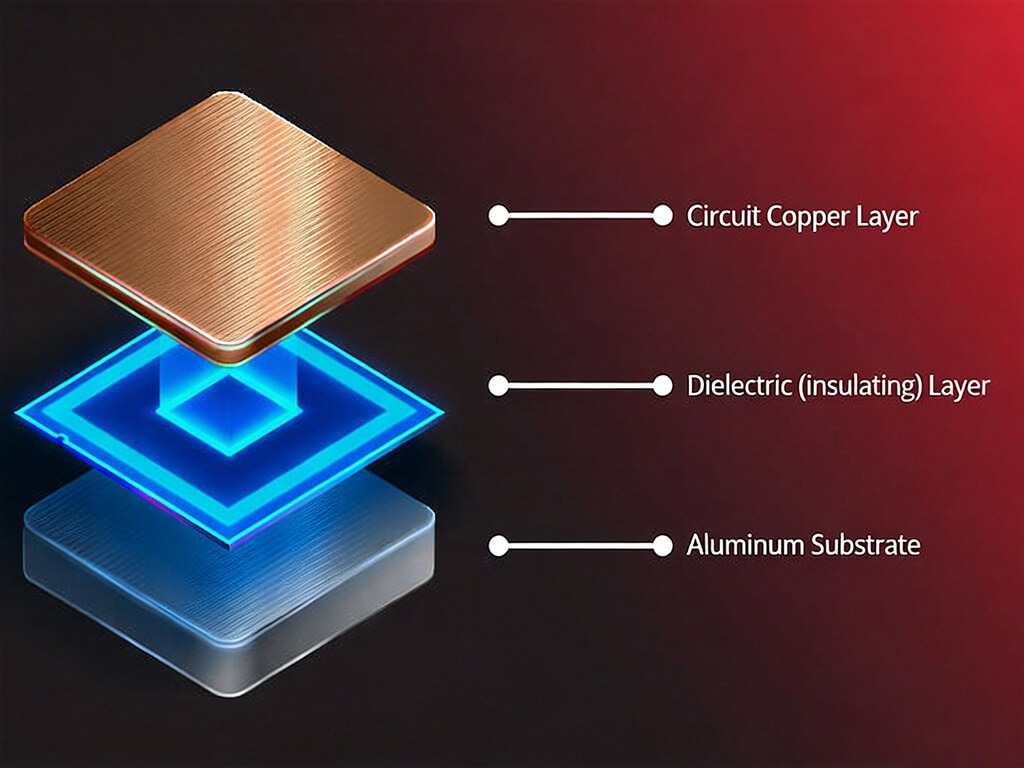
Structure of Metal Core PCBs

PCBCool’s capabilities go beyond manufacturing to offer a full end-to-end delivery system. We provide flexible and customized MCPCB solutions tailored to your specific project requirements.

  • Answer Engineering Support
  • Answer PCB Fabrication
  • Answer PCBA Assembly
  • Answer Box Build / System Integration
  • Answer Testing & Validation
  • Answer Supply Chain & Logistics
Structure of Metal Core PCBs
Metal Core PCB board

Cutting-Edge Technologies

Metal Core PCB board

PCBCool’s factories are equipped with advanced drilling and processing equipment, including Taliang NTL-DG6H, YAYA SC-200, Jung Chao MDP-10, and RYOSEI 40HP, ensuring high-precision execution for complex MCPCB projects.

  • Answer 1–6 layer metal substrate processing with min hole 0.2 mm
  • Answer Copper thickness 1–3 oz standard, up to 33 oz thick
  • Answer Supports both metal-core and metal-backed structures
  • Answer RF MCPCB with high-frequency materials (Rogers, Taconic, etc.)
  • Answer Supports direct chip-on-board bonding on MCPCB
  • Answer MCPCB 80k m²/month with PCBA 15M SMT points/day

Why Choose PCBCool as Your MCPCB Manufacturer

MCPCB manufacturing and assembly projects demand exceptional thermal management, high current carrying capacity, and precise processing.

If you want your engineering team involved early in the project to provide proactive support—

Frequently Asked Questions

Q1: Are MCPCB and IMS PCB the Same?

A: Yes, MCPCB is also known as IMS (Insulated Metal Substrate). They are essentially the same, with different naming conventions.

Q2: What Materials Are Used in MCPCB?

A: Common materials include aluminum and copper. Aluminum is the most widely used due to its balance of cost and performance, while copper is suitable for higher power density applications. In some special cases, stainless steel or customized metal alloys may also be used, though less common.

Q3: What Is the Difference Between Metal Core and Metal-Backed PCB?

A: Metal core typically refers to a PCB structure that includes a metal base within the board, while metal-backed PCB usually refers to a structure where an additional metal layer is attached to the back of the PCB for heat dissipation.

Q4: What Is the Thermal Conductivity of MCPCB?

A: Thermal performance mainly depends on the dielectric layer. Standard aluminum-based MCPCBs typically offer thermal conductivity of about 1–4 W/m·K, while copper-based solutions can reach approximately 3–5 W/m·K.

Q5: Can MCPCB Achieve Hole Sizes Below 0.1 mm?

A: For mechanical drilling, the minimum hole size on metal substrates is typically around 0.2 mm. Smaller holes require laser drilling, which is more challenging due to the presence of the metal layer and must be evaluated based on the specific design.

Q6: How Much Current Can MCPCB Carry?

A: Current-carrying capacity depends on copper thickness, trace width, and thermal design. Thick copper structures (such as 10 oz and above), combined with proper layout, can support high-current applications such as power modules and power electronics systems.

Q7: Can MCPCB Be Used for RF Applications?

A: Yes. This is typically achieved using a metal-backed structure combined with high-frequency materials such as Rogers or Taconic, enabling both effective heat dissipation and RF performance in a hybrid design.

Q8: Why Is MCPCB More Expensive Than Standard PCB?

A: MCPCB manufacturing is more complex, especially in drilling metal layers, which leads to higher tool wear and longer processing time. In addition, material costs and yield control requirements are higher.

Q9: Does PCBCool Provide MCPCB Assembly Services?

A: Yes, we offer one-stop services from bare board manufacturing to full PCBA assembly. Whether it is consigned assembly or turnkey solutions, we can support based on your project requirements.

Q10: Do You Support Engineering Evaluation for MCPCB Projects?

A: Yes. At the early stage of the project, our engineering team can provide DFM analysis, thermal design optimization suggestions, and material selection support to reduce risks and improve reliability.

Q11: Do You Support Thick Copper MCPCB (Such as Above 20 oz)?

A: Yes, we have the capability to manufacture thick copper MCPCBs, supporting up to 33 oz copper thickness, suitable for high-current and high-power applications.

Q12: What Is the Lead Time for MCPCB Projects?

A: Due to the complexity of MCPCB manufacturing, lead time depends on the design structure and process requirements. For urgent projects, expedited services are available upon evaluation.

Q13: How to Start an MCPCB Project with PCBCool?

A: Simply provide Gerber files, BOM list, or technical requirements. Our team will quickly complete engineering evaluation and provide a quotation along with optimization suggestions.

With PCBCool, You Get More Than Assembly

you get a partner committed to zero defects, global compliance, and lasting reliability.