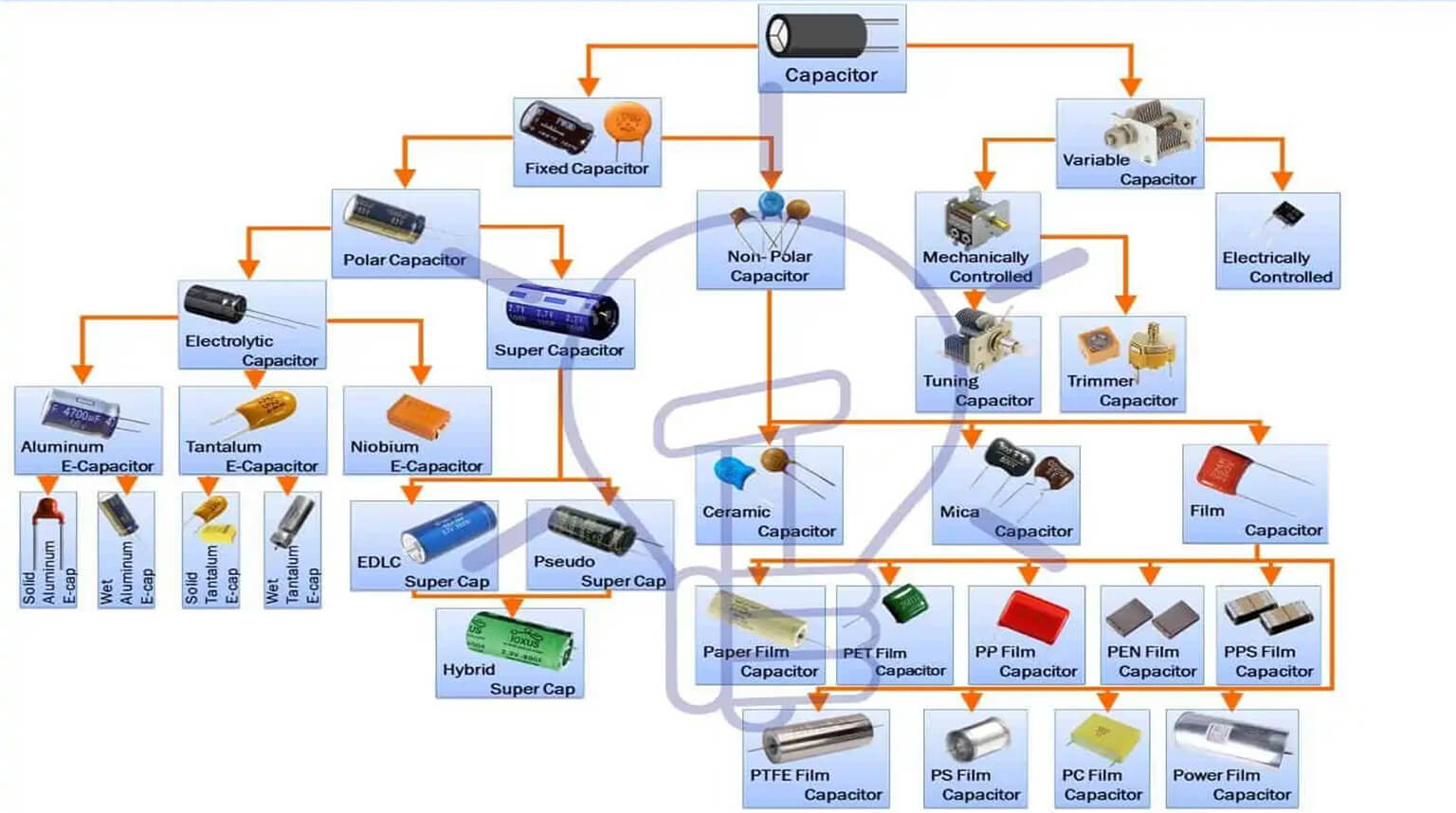
A capacitor is an electronic component that stores electrical charge and energy in an electric field. Along with resistors, capacitors are among the most common components found in electrical and electronic circuits. They are widely used in telecommunications equipment such as radio receivers for frequency tuning, as well as in timing circuits, oscillators, and filters. In this article, we will cover the basic features of capacitors, their main functions, and the different types and applications of these essential components.
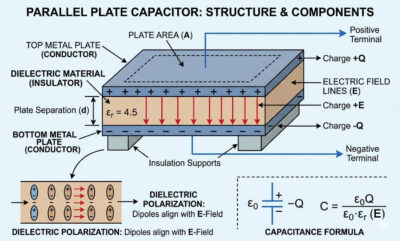
A capacitor is formed by any pair of conductors, the typical form being two parallel plates, i.e., two conductors or electrodes separated by a dielectric material of uniform thickness. The conductors can be any material that will conduct electricity easily. The dielectric material must be a poor conductor, that is, an insulator. A capacitor has the ability to store a quantity of static electricity.
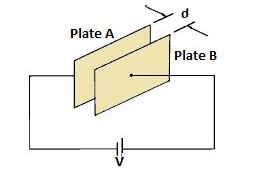
Static electric fields arise from electric charges, with electric field lines beginning and ending on electric charges. Thus, the presence of equal positive and negative electric charges on the two plates of Figure 2 below:
Let’s assume the charge +Q coulombs on plate A and –Q coulombs on plate B. The property of this pair of plates that determines how much charge corresponds to a given voltage between the plates is referred to as capacitance, denoted by C:
C = Q / V
The unit of capacitance is coulombs per volt or farads (F), which is defined as the capacitance when a voltage of one volt appears across the plates when charged with one coulomb. In practice, most capacitors have values much smaller than one farad and are commonly expressed in microfarads (µF, 10⁻⁶ F), nanofarads (nF, 10⁻⁹ F), or picofarads (pF, 10⁻¹² F).
For the case above in Figure 1, the capacitance C is given by:
C = εA / d
Wo
- A is the area of one plate
- d is the distance between the plates
- ε is the permittivity of the dielectric material between them
For an ideal capacitor, capacitance depends only on the physical characteristics of the device. When purchasing a capacitor, you must specify its voltage rating in addition to its capacitance value. This rating tells you the maximum voltage you can apply across the capacitor before there is an electrical breakdown through the dielectric material.
As mentioned earlier, capacitors are used for energy storage. In this case, the charge from an applied current is stored within the capacitor, and it is later released back into the circuit as current that can be used.
By placing a resistor in series with the capacitor, you can actually control the rate of charging and discharging. This concept is often employed in high-current discharge circuits such as photoflashes as well as small energy backup supplies for low-power memory ICs. Additionally, it is used to smooth out power supply ripple, control timing in Integrated circuits, and modify the shape of the waveforms.
When a capacitor is placed in series with a signal path, it blocks DC while allowing AC signal components to pass. When a capacitor is utilized in this way, it is termed a DC-blocking or AC-coupling capacitor.
To explain how this works – at DC, a capacitor’s impedance is ideally infinite – no current flows, no DC levels within a mixed signal are allowed to pass. But, if an AC signal is applied, the capacitor’s impedance becomes a finite value that is dependent upon the frequency of the signal – which implies that the higher the frequency, the lower the impedance. Thus, in effect, a series capacitor can be used to couple two circuits together without introducing unwanted DC shifts into the next stage; furthermore, it can control how much of a given frequency signal gets through, i.e., it controls the attenuation.
Let’s consider a case where the capacitor is placed in parallel with a signal path (that is to the ground). This has an effect that is opposite to that of the coupling capacitor discussed above. Here, it acts as a decoupling capacitor, allowing DC to continue along the path, whilst diverting high-frequency signal components to ground – the capacitor acting as a low-impedance path to ground.
A similar effect occurs when a capacitor is placed across a particular circuit element to divert unwanted frequencies around it – this is referred to as bypassing.
Decoupling and bypassing are important when there is a need to remove unwanted random high-frequency ripple and other undesired signals caused by random noise or sudden current demands generated by accompanying circuit elements.
These are just some of the basic functions of capacitors. There are more functions but we won’t delve into them, for example, the use of capacitors in passive and active filter networks, LC resonant circuits, etc.
Tantalum electrolytic capacitor has become one of the preferred capacitor types where high reliability and long service life are key considerations.
Tantalum capacitors contain either liquid or solid electrolytes. The liquid electrolyte in wet-slug and foil capacitors – generally sulfuric acid – forms the cathode (negative) plate. In solid capacitors, a dry material, manganese dioxide, forms the cathode plate.
The anode lead wire from the tantalum consists of two pieces: A tantalum lead embedded in, or welded to, the pellet, which is welded in turn to a nickel lead.
- Small size for a given capacitance
- Good capacitance stability over temperature
- Relatively low leakage current
- Good reliability when used within rated conditions
- Useful capacitance values in compact designs
- Usually polarized
- More expensive than aluminum electrolytic capacitors
- Sensitive to current surges, reverse voltage, and overvoltage
Tantalum capacitors aren’t suitable for storage or high-frequency (HF) coupling applications due to poor isolation resistance and internal inductance. Tantalum capacitor acts more like an inductor than a capacitor above a few MHz.
Tantalum capacitors’ applications include blocking, bypassing, decoupling, filtering, and timing.
Typically used as a ripple filter in power supplies or as a filter to bypass low-frequency signals.
Aluminum electrolytic capacitors have space between their foil plates filled with a chemical paste. When a voltage is applied, a chemical reaction forms a layer of insulating material on the foil.
Since aluminum electrolyte capacitors provide high capacitance values in small packages at an affordable price, they are very popular and you will likely find them in almost every type of electronic circuit.
Typical capacitance values range from about 0.1 µF to500000µF.
- High capacitance values at a relatively low cost
- Widely available in many sizes and voltage ratings
- Useful for power supply filtering and bulk energy storage
- Good capacitance-to-cost ratio
- Can handle high currents and voltages
- Usually polarized
- Higher leakage current than ceramic or film capacitors
- Wider tolerance and lower stability than some other capacitor types
- Higher internal resistance and inductance
- Shorter service life than some non-electrolytic capacitor types, especially at high temperatures
They are not suitable for high-frequency coupling applications due to poor isolation resistance and internal inductance.
These capacitors are used in ripple filters in power supplies, audio coupling, and or as a filter to bypass low-frequency signals.
An important factor to keep in mind when dealing with this type of capacitor is that they will explode if the rated working voltage is exceeded or polarity is reversed. Therefore, you shouldn’t apply an AC voltage across an electrolytic capacitor. Nonetheless, if an AC voltage is superimposed on a DC voltage, ensure that the peak value does not exceed the voltage rating.
Another key consideration is that aluminum electrolytic capacitors shouldn’t be used if the DC potential is well below the capacitor’s working voltage.
Glass dielectric capacitors provide the highest performance and reliability features available in the capacitor industry.
The construction of glass capacitors is pretty simple. They consist of only three elements:
- Glass dielectric and case
- Aluminum electrodes
- Wire terminals
The capacitors are made in a multilayer manner with the leads being welded to the electrodes so that there are no pressure connections to come loose and no solder connections to melt.
The dielectric is formed as a continuous ribbon of glass having physical and electrical properties and dimensions precisely controlled.
The glass dielectric capacitors comprise alternate layers of glass ribbon and the electrode material. After the assembly, the units are sealed together by high temperature and pressure to form a rugged monolithic block. Because the terminal leads are fused to the glass case, the seal can’t be broken without destroying the capacitor.
Whereas these capacitors are of monolithic structure, they are not necessarily hermetically sealed since the coefficient of thermal expansion of the terminals does not match that of the case.
The glass capacitors may be enclosed in glass or vitreous enamel cases appropriately protected against the environmental conditions.
Glass capacitors are made of inorganic materials and are highly resistance to high operating temperatures, voltage breakdown, and nuclear radiation. Glass capacitors won’t become a toxic hazard when exposed to radiation.
- High reliability and long-term stability
- Low dielectric absorption
- High insulation resistance
- High Q and low loss at high frequencies
- Good performance at elevated temperatures
- Strong resistance to humidity, shock, vibration, and radiation
- Higher cost than more common capacitor types
- Lower capacitance values than many other capacitor types
- Larger size and higher cost for a given capacitance
- Less common and sometimes harder to source than standard capacitor types
Glass capacitors have typically seen widespread application in military applications, with increasingly large new designs happening in the aerospace and high-performance sectors.
Glass capacitors are used especially where reliability is critical, and the replacement of a failed part is not possible or practical.
Glass capacitors have wide applications that include:
- High-temperature circuitry
- Modulators
- RF amplifier output filters
- Variable-frequency oscillators
- Amplifier coupling
- Sample-hold
- Voltage snubbers
- Transistor biasing
- Ramp integrators
Basically, these capacitors are constructed with materials such as titanium acid barium for the dielectric. Internally, these capacitors are not constructed as a coil, so they have low inductance.
To meet market demand for high-density ceramic capacitors, Multilayer Ceramic Capacitors (MLCCs) were developed; they incorporate multiple printed layers of electrode plates made of thin ceramic sheets.
Ceramic capacitors can be classified into 3 types based on their dielectric characteristics.
This is the most stable capacitor, made from a mixture of titanates. It has a very predictable temperature coefficient (TCs), and generally doesn’t have aging characteristics.
The most popular ultra-stable ceramic capacitor is the NP0 (negative-positive 0 ppm/°C) or C0G (as per EIA designation).
These aren’t as temperature-stable as the ultra-stable capacitors; nonetheless, they have a higher electrostatic capacity.
All semistable capacitors vary in capacitance value under the effect of temperature, operating voltage (ac and dc), and frequency.
Semistable capacitors are best suited for applications where high capacitance values are essential, while Q stability over temperature is not a major concern.
This type has a high dielectric constant or electrostatic capacity, but has poor stability, poor dielectric absorption, and a high voltage coefficient, and is sensitive to vibration.
There is very poor temperature drift, high voltage coefficient of dissipation, high frequency coefficient of capacitance, and a significant aging rate.
They exhibit low inductance, a wide range of values, a small size, and have a higher density than dipped ceramic.
They are generally best suited for coupling (dc blocking) and power supply bypassing.
Typically recommended for linear applications where performance and stability aren’t of great concern.
Ceramic capacitors are principally designed for use where a small physical size with comparatively large electrical capacitance and high insulation resistance is required.
Typical applications for general-purpose ceramic capacitors include:
- Resistive-capacitor coupling for audio and radio frequency
- RF and intermediate frequency cathode bypass
- Tone compensation
- Automatic volume control filtering
- Volume control RF bypass
- Antenna coupling
- Audio-plate RF bypass
Capacitors perform important functions in electronic circuits that range from simple functions such as energy storage to major functions such as DC-blocking or AC-blocking.
There are different types of capacitors, used for various applications. Choosing the right one may not be that easy a task. Understanding the various capacitor types, their features, and capabilities, provides you with the needed knowledge to help you make a better decision when choosing a capacitor for a given application.
Bei PCBCool, we offer complete electronic manufacturing services, including Komponentenbeschaffung, Leiterplattenbestückung, and end-to-end production support. No matter how simple or challenging your project may be, we can help deliver the right solution, including sourcing components from your specified brands when required.