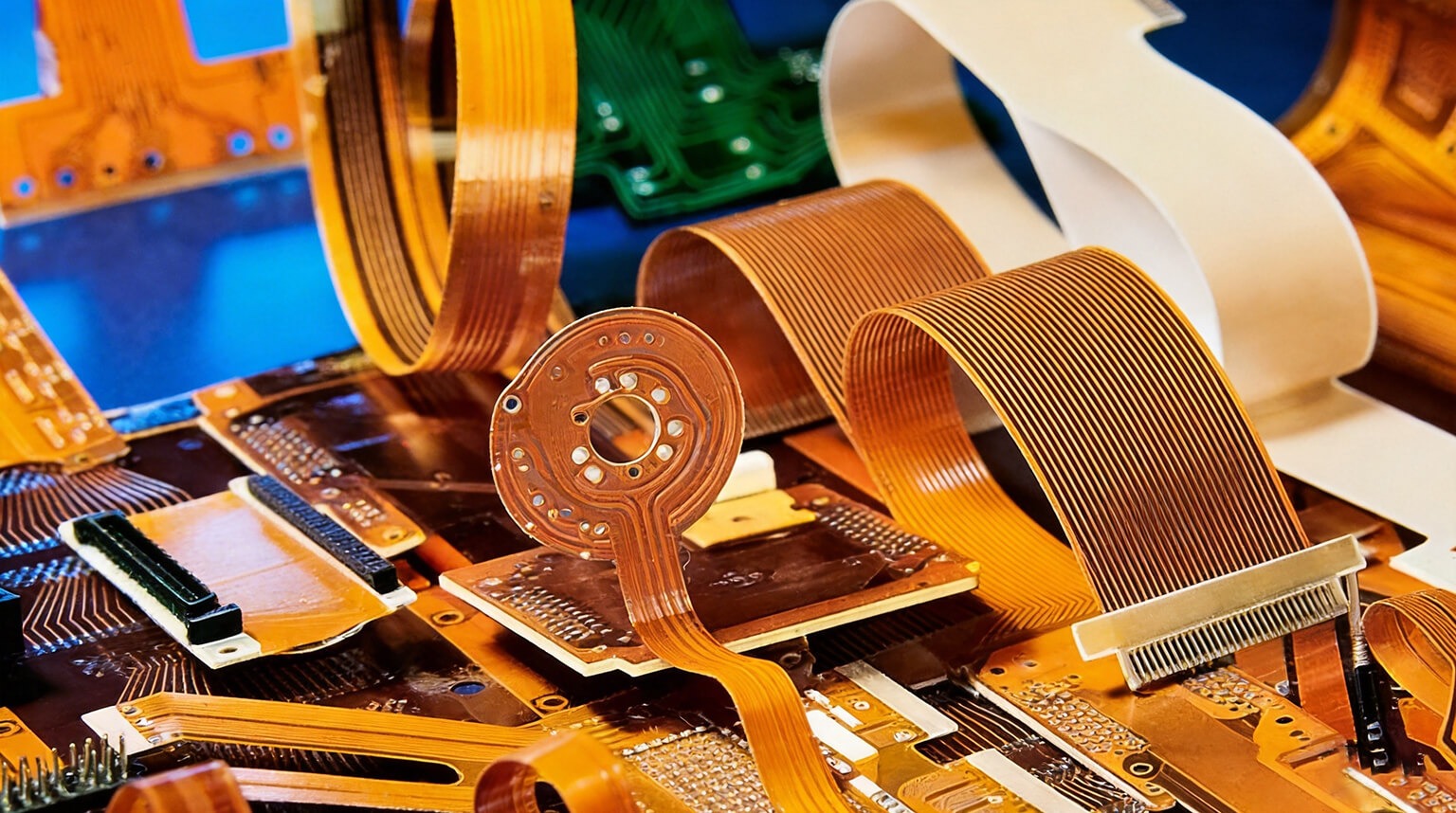
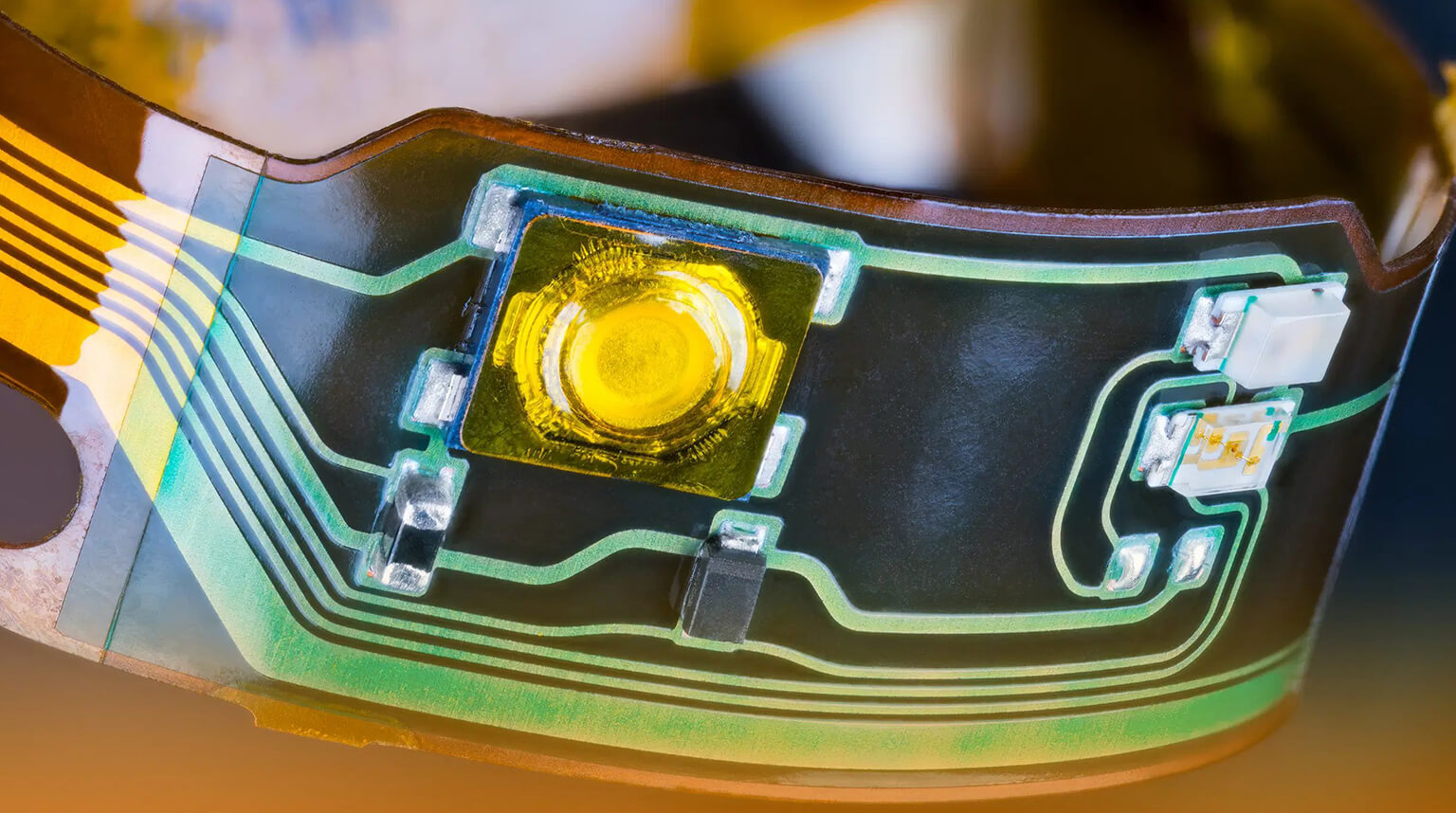
Flexible printed circuit board—commonly referred to as flex circuits or FPC—has become a core technology in modern electronic systems. They enable compact layouts, reduced weight, and three-dimensional interconnections that are difficult or impossible to achieve with traditional rigid PCB.
Unlike rigid PCB that typically rely on FR-4 as the base laminate, flexible PCB use thin, bendable polymer films as their primary dielectric substrate. This fundamental difference means that material selection plays a far more critical role in flexible PCB performance, manufacturability, and long-term reliability.
Selecting a flexible PCB material requires evaluating both mechanical and electrical requirements within real manufacturing constraints. Key considerations include the flexing mode (static or dynamic), minimum bend radius, operating temperature range, resistance to chemicals or moisture, electrical performance at the target signal frequencies, and overall cost targets.
In today’s market, flexible PCB substrates are dominated by three material families: polyimide (PI), polyester (PET), and liquid crystal polymer (LCP). Each material offers distinct advantages and limitations in terms of flexibility, thermal performance, process compatibility, and cost. The following sections examine each material in detail and provide a practical comparison to support informed material selection.
Polyimide film is the most widely used substrate material for flexible PCB. It has remained the industry standard for decades because it offers a well-balanced combination of thermal stability, mechanical durability, and reliable electrical performance. For most flex and rigid-flex PCB applications, polyimide provides the broadest processing window and the highest manufacturing maturity.
One of polyimide’s key advantages is its excellent thermal stability. Depending on the formulation, polyimide films can operate continuously at temperatures between 200 °C and 260 °C. They also tolerate short-term temperature excursions above 300 °C, which commonly occur during PCB assembly processes such as reflow soldering and selective wave soldering. This thermal margin allows flexible PCB based on polyimide to be assembled using standard SMT profiles without special low-temperature solders or process adjustments.
From a mechanical perspective, polyimide performs particularly well in both static and dynamic flexing applications. Standard film thicknesses range from 12.5 µm to 125 µm, with 25 µm, 50 µm, and 75 µm being the most commonly specified in production. Thinner films enable tighter bend radii and improved flexibility, while thicker films provide increased mechanical strength and handling robustness during fabrication and assembly.
When properly designed, polyimide-based flex circuits can withstand millions of bending cycles in dynamic applications such as hinges, connectors, and moving assemblies. The material also offers good dimensional stability and high tensile strength, which helps maintain registration and trace integrity throughout critical manufacturing steps including lamination, drilling, copper plating, etching, and final assembly.
Polyimide provides stable and predictable electrical insulation performance across a wide range of operating conditions. Its dielectric constant typically falls between 3.4 and 3.5, with a relatively consistent dissipation factor over commonly used signal frequencies.
While polyimide is not a low-loss material optimized for very high-frequency RF applications, it delivers dependable signal performance for the majority of flexible PCB designs.
Despite its versatility, polyimide does have some limitations that designers must account for. One of the most important is moisture absorption, which typically ranges from 1% to 2% by weight. If moisture is not properly removed through controlled baking prior to assembly, rapid heating during soldering can cause delamination, blistering, or internal stress within the flex circuit.
Cost is another consideration. Polyimide films are more expensive than polyester-based alternatives, which may impact material selection in high-volume, cost-sensitive products where extreme thermal or mechanical performance is not required. As a result, polyimide is often chosen for applications where reliability, process compatibility, and long service life outweigh raw material cost.
Polyester film—most commonly polyethylene terephthalate (PET)—is used in flexible PCB designs where cost control is a primary objective and demanding thermal or mechanical performance is not required.
PET has a significantly lower thermal tolerance than polyimide. Depending on the material grade and adhesive system, continuous operating temperatures are typically limited to approximately 105 °C to 150 °C. This constraint generally excludes PET from applications that require standard SMT reflow soldering or prolonged exposure to elevated operating temperatures.
From a mechanical standpoint, PET is best suited for static flex or single-bend designs. It performs adequately in applications where the circuit is bent once during installation and remains fixed throughout its service life. However, PET exhibits relatively poor fatigue resistance under repeated bending and should not be used in dynamic flex environments that involve frequent or continuous motion. Designs that require thousands or millions of flex cycles are better served by polyimide-based substrates.
PET films are commonly available in thicknesses ranging from 25 µm to 125 µm. Thinner films improve flexibility but require tighter process control during fabrication due to reduced mechanical strength and handling tolerance.
Electrically, PET provides acceptable insulation performance for many low- to moderate-frequency applications. Its dielectric constant typically falls between 3.0 and 3.2, which is suitable for basic signal transmission in simple control circuits, displays, membrane switches, and similar products where signal integrity requirements are modest.
In terms of environmental behavior, PET generally absorbs less moisture than polyimide, depending on the formulation. Lower moisture uptake reduces the risk of blistering or delamination during thermal exposure, particularly in assembly processes that avoid high-temperature reflow. PET also offers good optical transparency, which can be advantageous in applications where the flexible circuit is visible, such as touch interfaces, backlit displays, or decorative lighting assemblies.
The primary advantage of PET is cost. Both the raw material and finished flexible circuits are significantly less expensive than polyimide-based designs. This makes PET an attractive option for high-volume consumer products where material cost, manufacturing efficiency, and acceptable performance must be carefully balanced.
However, PET’s lower thermal and mechanical margins require close coordination between design and manufacturing. Assembly methods, soldering processes, and operating conditions must be carefully defined to remain within the material’s limitations. When these constraints are properly managed, PET fills an important role in enabling economical flexible PCB solutions.
Liquid crystal polymer (LCP) is a high-performance thermoplastic substrate that has gained increasing adoption in advanced flexible PCB applications. It is often selected to overcome the limitations of polyimide and polyester in designs that demand low signal loss, minimal moisture absorption, and high dimensional stability.
LCP offers strong thermal performance suitable for modern PCB manufacturing and assembly processes. Many LCP grades support continuous operating temperatures from approximately 180 °C up to 260 °C, combined with low thermal expansion and minimal outgassing. These characteristics make LCP compatible with standard lead-free reflow soldering profiles when properly processed.
From a mechanical standpoint, LCP provides good flexibility and stable mechanical behavior. While its fatigue resistance under extreme dynamic flexing is generally lower than that of high-grade polyimide films, it remains sufficient for most real-world applications.
The primary advantage of LCP lies in its electrical performance, particularly at high frequencies. LCP exhibits a low dielectric constant, typically in the range of 2.9 to 3.0, along with an extremely low dissipation factor that remains stable from low frequencies through millimeter-wave bands.
Compared to polyimide, LCP significantly reduces signal loss, phase distortion, and impedance variation, which are critical factors in high-frequency system performance.
LCP films are commonly available in thicknesses ranging from 25 µm to 100 µm. Thinner constructions are frequently selected in high-frequency designs to reduce dielectric thickness and improve impedance control.
LCP’s near-zero moisture absorption—typically below 0.05% by weight—is another major advantage. This characteristic largely eliminates the need for pre-bake drying prior to assembly and significantly reduces the risk of blistering, delamination, or internal stress during thermal processing. As a result, LCP-based flexible PCB often demonstrate higher assembly yields and improved long-term reliability in humid or harsh environments.
In addition, LCP offers excellent chemical resistance and outstanding dimensional stability. These traits help maintain tight tolerances during lamination, drilling, and fine-line patterning, making LCP a strong candidate for multilayer flexible circuits and high-density interconnect designs.
Despite its performance benefits, LCP presents higher material costs and greater processing complexity compared to polyimide and polyester. Lamination parameters such as temperature, pressure, and dwell time must be carefully controlled, and material handling requires tighter process discipline. As a result, not all flexible PCB manufacturers have the equipment or experience necessary to produce LCP-based circuits consistently.