

Blog

SMD-Widerstandsgrößentabelle

0
SMD-Widerstandsgrößentabelle

Surface-mount device (SMD) resistors are the default choice in modern electronics. They solder directly onto the PCB surface, take up far less space than through-hole parts, and make it possible to build compact, high-density circuits used in smartphones, automotive control units, and industrial modules.

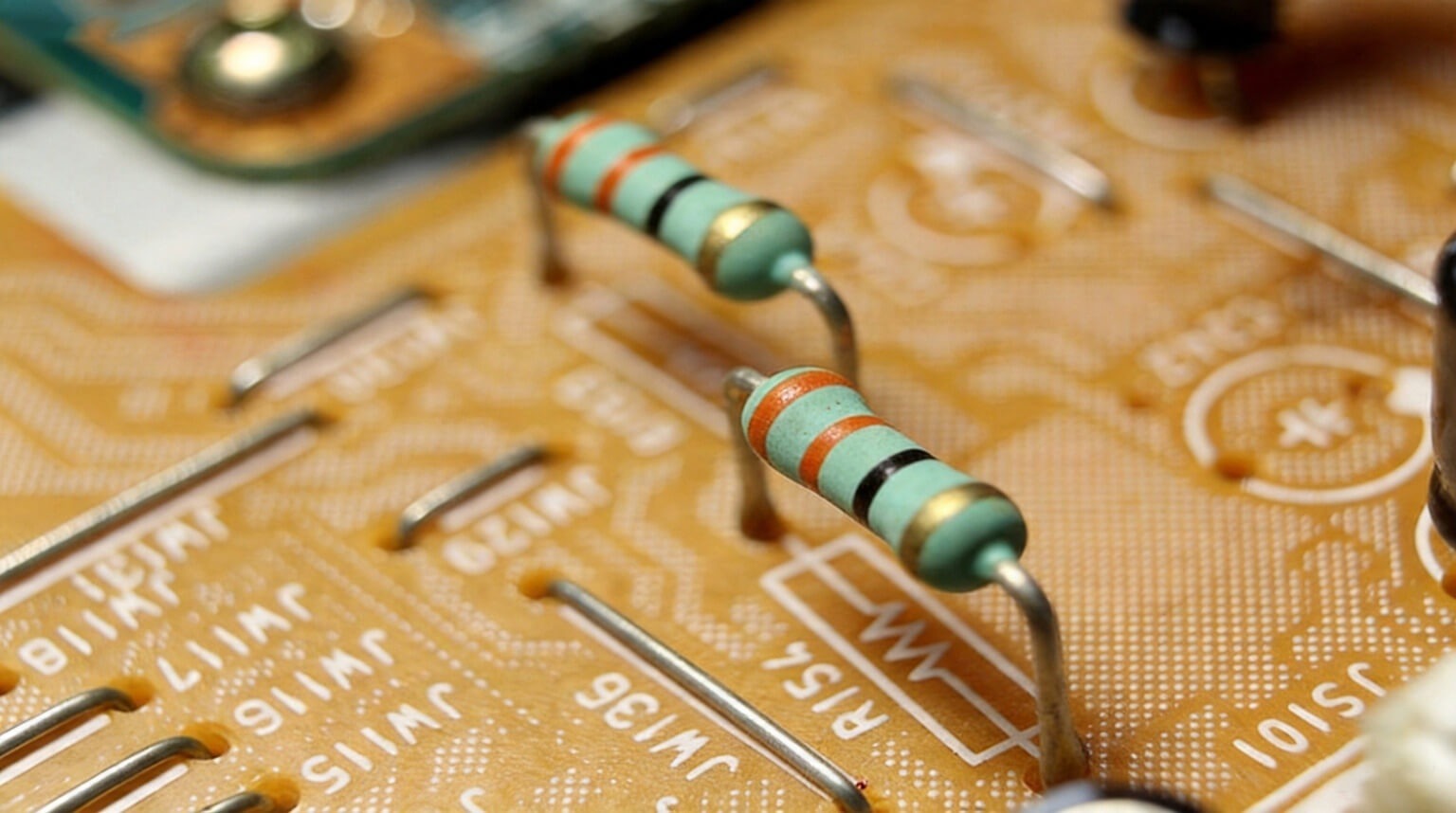
Unlike through-hole resistors, SMD resistors do not use color bands. They are identified mainly by package size codes such as 0402, 0603, 0805, and 1206. These codes describe the physical footprint of the component, not its resistance value.

That is where an SMD resistor size chart becomes useful. It connects those package codes with real dimensions, metric equivalents, and typical power ratings, so designers can quickly understand what each size means before choosing a footprint, ordering parts, or preparing a PCB for assembly.

Imperial vs. Metric Size Codes

SMD resistor sizes are usually described using either an imperial code or a metric code. Confusing the two is one of the most common mistakes when reading datasheets, footprint libraries, or distributor listings.

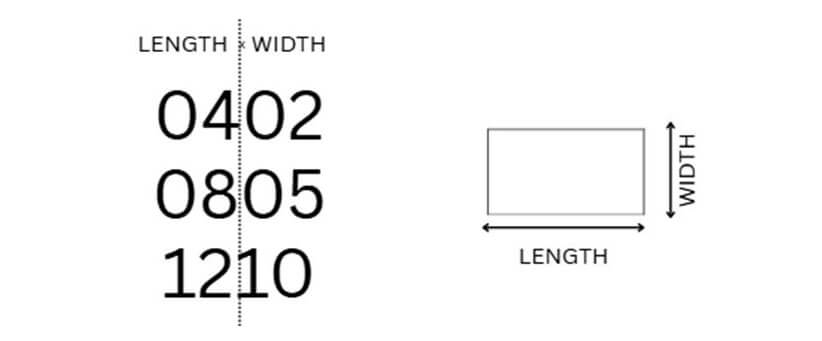
In the imperial system, the first two digits represent the component length in hundredths of an inch, and the last two digits represent the width in hundredths of an inch. For example, an imperial 0603 resistor is approximately 0.06 inches long and 0.03 inches wide.

In the metric system, the first two digits represent the length in tenths of a millimeter, and the last two digits represent the width in tenths of a millimeter. For example, a metric 1608 resistor is approximately 1.6 mm long and 0.8 mm wide.

Explanation of SMD Resistor Package Codes

This is where confusion begins: imperial 0603 and metric 0603 are not the same size. Imperial 0603 is 1.6 mm × 0.8 mm, while metric 0603 is 0.6 mm × 0.3 mm, which is equivalent to imperial 0201.

The safest rule is simple: always confirm whether the code is imperial or metric before selecting a footprint or ordering parts.

Common SMD Resistor Size

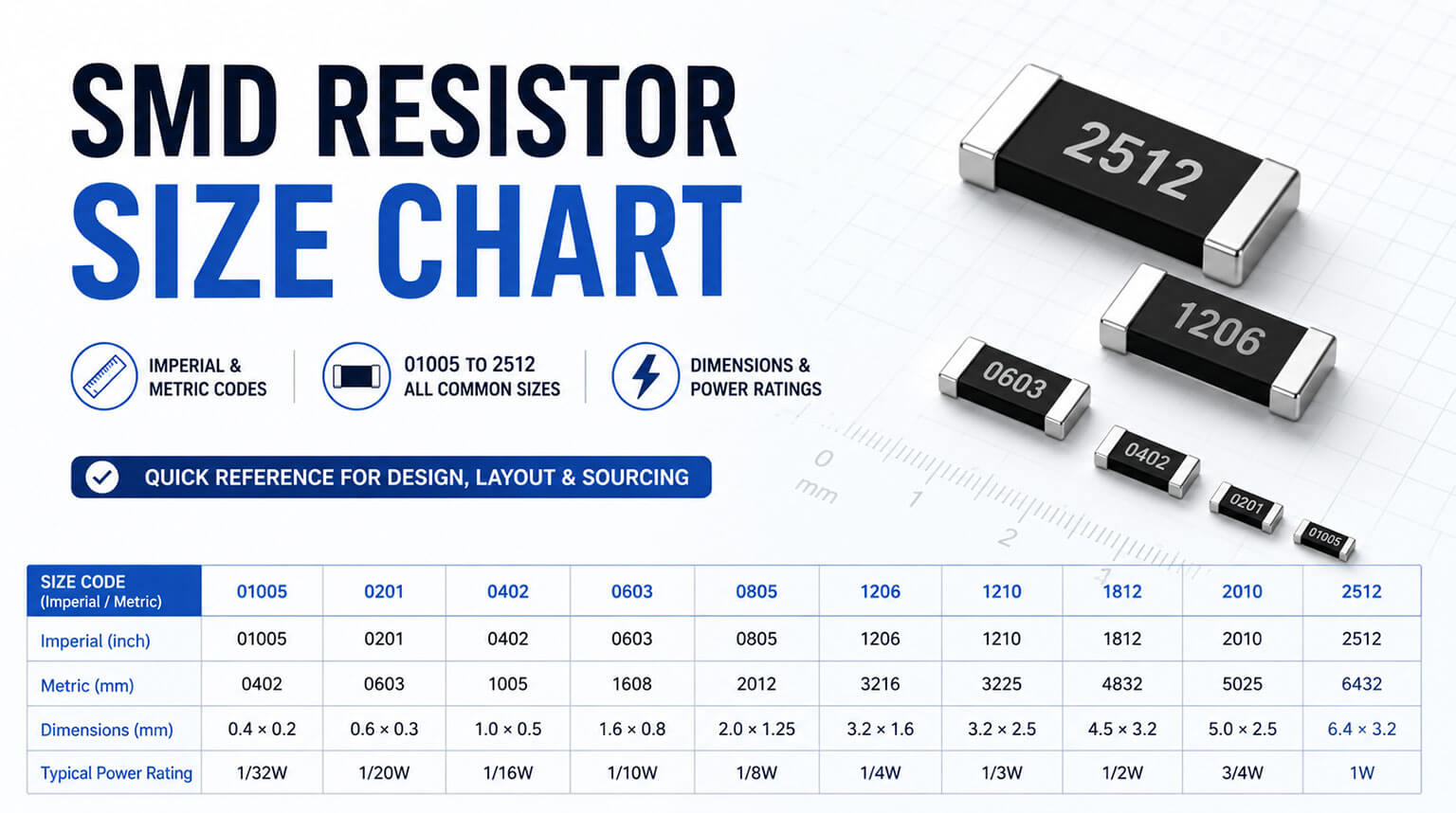
The chart below shows common SMD resistor packages, their equivalent imperial and metric codes, nominal dimensions, and typical power rating ranges. These power ratings are general references for standard thick-film chip resistors at around 70°C ambient temperature.

Imperial CodeMetric CodeApprox. Size (mm)Approx. Size (inch)Typical Power Rating
0100504020.4 × 0.2 mm0.016 × 0.008 in1/32 W to 1/20 W
020106030.6 × 0.3 mm0.024 × 0.012 in1/32 W to 1/20 W
040210051.0 × 0.5 mm0.039 × 0.020 in1/16 W to 1/10 W
060316081.6 × 0.8 mm0.063 × 0.031 in1/10 W to 1/5 W
080520122.0 × 1.25 mm0.079 × 0.049 in1/8 W to 1/4 W
120632163.2 × 1.6 mm0.126 × 0.063 in1/4 W to 1/2 W
121032253.2 × 2.5 mm0.126 × 0.098 in1/3 W to 1/2 W
181245324.5 × 3.2 mm0.177 × 0.126 in1/2 W to 1 W
201050255.0 × 2.5 mm0.197 × 0.098 in1/2 W to 1 W
251263326.3 × 3.2 mm0.248 × 0.126 in1 W to 2 W
SMD Resistor Size Comparison Chart

How Package Size Affects Performance

Package size is not just about board space. It also changes a resistor’s thermal margin, parasitic behavior, and resistance stability in real circuits.

Larger packages dissipate heat more efficiently, so a 1206 resistor will usually run cooler than a 0402 resistor under the same power load. If the package is too small for the actual dissipation, the result can be value drift, shorter service life, solder-joint stress, or even PCB damage.

At higher frequencies, package size also becomes part of the electrical behavior. Larger resistors such as 1206 or 2512 generally add more parasitic inductance and capacitance than 0402 or 0201. In ordinary low-frequency circuits, this rarely matters. On high-speed USB lines, RF traces, or fast-switching power supplies, it can become part of the signal-integrity problem, which is why a smaller package can be a performance choice rather than just a space-saving choice.

TCR is specified by the resistor series and datasheet, not by package size alone. But smaller resistors have less thermal mass, so they can heat up faster and drift more under the same load. In precision circuits such as voltage dividers, current-sense feedback loops, or analog measurement paths, that real operating temperature can matter as much as the tolerance number on the datasheet.

Assembly Methods That Match SMD Resistor Package Size

Assembly difficulty rises quickly as the part gets smaller:

  • 0805 and 1206 — The most forgiving choices for hand assembly, inspection, and rework. They are suitable for prototypes, test boards, and low-volume builds.
  • 0603 — Still practical by hand with good lighting, flux, fine tweezers, and careful solder control. It is often a good balance between compact layout and manual rework.
  • 0402 — Possible to solder by hand, but much less forgiving. Magnification and an ultra-fine tip are usually needed, especially for repeated rework.
  • 0201 and 01005 — Better treated as reflow-first packages. Manual placement is possible with hot air, solder paste, magnification, and experience, but they are not ideal for boards that may need hand repair.

In fact, in modern PCBA manufacturing, SMD resistors are usually handled through standard SMT production rather than manual soldering. Solder paste is printed by stencil, components are placed by pick-and-place machines, and the board then passes through reflow. This process makes even small packages practical for volume production.

That does not mean small packages are risk-free. They still depend on accurate stencil design, placement control, and a stable reflow profile. For common SAC305 lead-free solder paste, peak temperatures often fall around 235–250°C, depending on the paste, PCB thickness, copper distribution, and oven setup. For 0402 and smaller packages, the process window becomes tighter because tiny parts react quickly to paste imbalance and thermal differences.

Abschließende Gedanken

By the time an SMD resistor reaches the BOM, the package choice has already become a production decision. A footprint that looks correct, a power rating that seems sufficient, or a value that appears common can still create problems if the part is hard to source, unsuitable for the assembly process, or difficult to replace during production.

PCBCool supports PCB assembly projects with component procurement, BOM review, and alternative sourcing. If your design depends on specific SMD resistor packages or values, our team can help check availability, identify practical substitutes, and keep the project moving toward stable production.

Häufig gestellte Fragen

Q1: What Is the Most Common SMD Resistor Size?

A: 0603 and 0805 are the most common choices because they balance size, availability, and assembly convenience.

Q2: Is 0402 Smaller Than 0603?

A: Yes. A 0402 resistor takes up roughly 60% less board area than a 0603 resistor.

Q3: Why Does 0603 Sometimes Mean Two Different Sizes?

A: Because imperial and metric codes use the same four-digit format. Imperial 0603 is 1.6 × 0.8 mm, while metric 0603 is 0.6 × 0.3 mm.

Q4: Does the Package Code Tell Me the Resistor Value?

A: No. The package code only tells you the physical size; the resistance value comes from the marking, BOM, datasheet, or reel label.

Q5: Why Do Some Small SMD Resistors Have No Markings?

A: Because their surface dimensions are too small to hold readable markings.

Q6: Can I Replace a 0603 Resistor With a 0402 Resistor?

A: Not by value alone. The footprint, power rating, voltage rating, and assembly process must also allow the replacement.

Q7: How Do I Know the Power Rating of an SMD Resistor?

A: Check the manufacturer’s datasheet.

Q8: Why Is Power Derating Important?

A: Because a resistor may not safely handle its full rated power in a hot enclosure or near heat-generating components.

Q9: Which SMD Resistor Size Is Easiest to Hand-Solder?

A: 0805 and 1206 are the easiest for hand soldering and rework. 0603 is still manageable with proper tools.

Q10: Are Smaller Resistors Always Better?

A: No. Smaller resistors save PCB space, but they are harder to assemble, harder to rework, and usually handle less power.

Q11: When Should I Use a Larger Resistor Package?

A: Use a larger package when you need better power dissipation, easier rework, or more thermal margin.

Q12: What Causes Tombstoning in Small SMD Resistors?

A: Tombstoning is usually caused by solder paste imbalance, uneven pad design, or uneven heating during reflow.

Q13: Are Zero-Ohm Resistors the Same as Wires?

A: Not exactly. They act as jumpers, but they still need the right footprint and current capacity.

Sam K
Sam K | Embedded Systems Engineer

Sam K arbeitet an eingebetteten elektronischen Systemen mit Schwerpunkt auf Hardware-Design, PCB-Entwicklung, Firmware-Programmierung und Systemintegration. Er unterstützt auch die Leistungsoptimierung und hilft bei der Umsetzung von Ideen für elektronische Produkte in zuverlässige, praxistaugliche Lösungen.

Verwandte Schlagwörter